Sanborn Papers: Archive Research Collection
In March 2026, we examined the Jim Sanborn papers at the Archives of American Art, Smithsonian Institution. The collection spans circa 1950–2023 and includes working cipher materials, design sketches, correspondence, production documents, and conceptual notes from Sanborn's career. This page presents a curated subset of photographs from our research visit, selected for their relevance to Kryptos and the unsolved K4 cipher. The selection prioritizes documents that reveal Sanborn's encryption thinking, keyword choices, construction methods, and conceptual framework.
Copyright & Research Use Notice
All photographs depict materials from the Jim Sanborn papers held at the Archives of American Art, Smithsonian Institution. Copyright in the original works depicted remains with Jim Sanborn and/or other applicable rights holders. No claim of ownership is made or implied.
These images are presented in good faith for purposes of non-commercial research, scholarship, education, and commentary regarding the unsolved Kryptos K4 cipher. The Archives of American Art is a public research repository of the Smithsonian Institution; these materials were examined in person under standard research access procedures, and photographs were taken in accordance with the archive's research photography policies.
We believe this use is consistent with principles of fair use under 17 U.S.C. § 107, but we do not present this as a legal conclusion. In accordance with the Digital Millennium Copyright Act (17 U.S.C. § 512), if you are the rights holder and believe any material here infringes your copyright, please send a written notice to contact@kryptosbot.com identifying the specific material and we will promptly remove or disable access to it.
1. “He Lied” & Coordinate Manipulation
Perhaps the most provocative single page in the entire collection: Sanborn's handwritten coordinates with a deliberate alteration and an emphatic annotation.
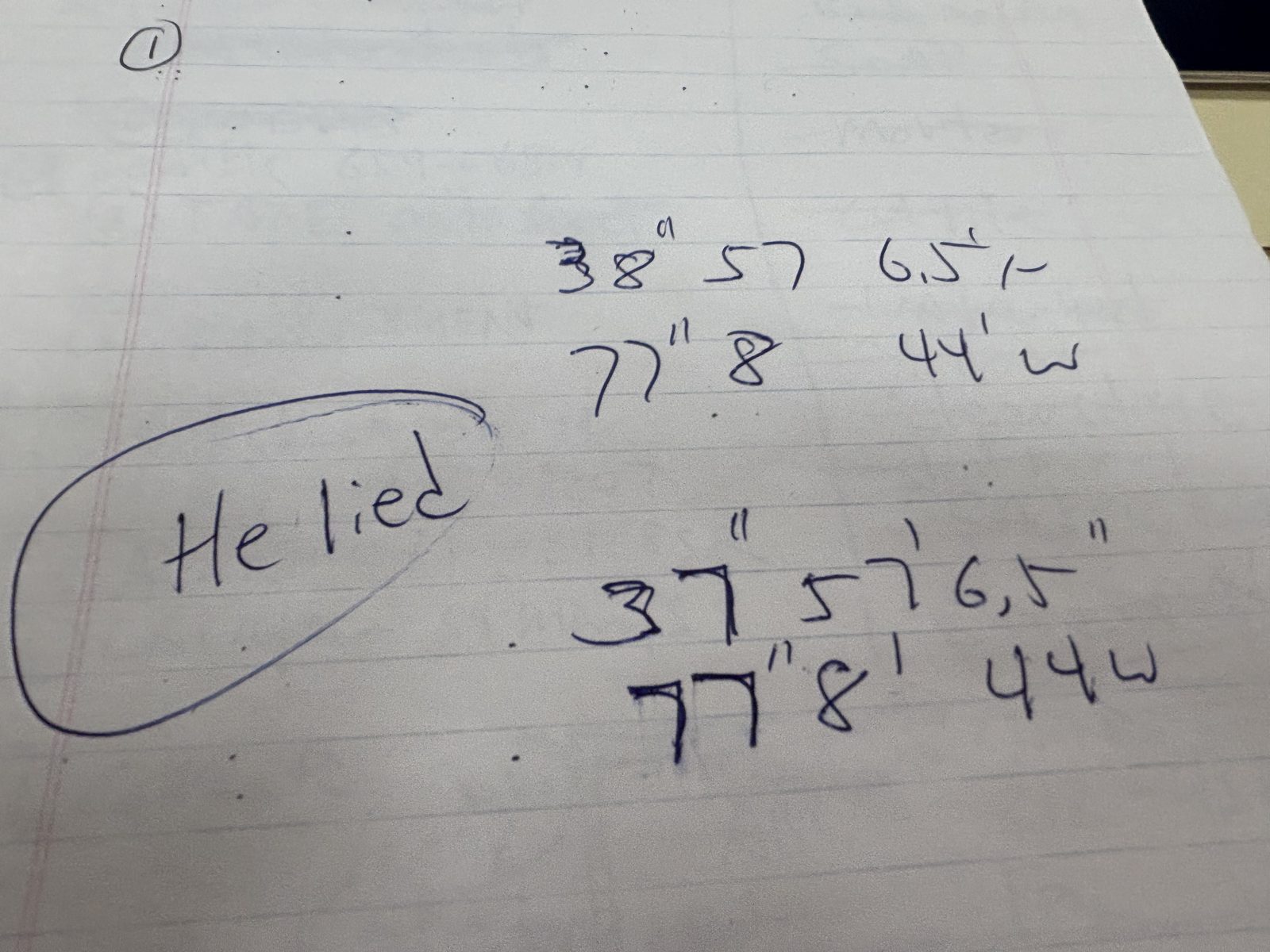
“He Lied”: Coordinate Manipulation
IMG_1384 (CRITICAL DOCUMENT)
Two coordinate sets in Sanborn's hand with “He lied” circled emphatically between them:
38° 57′ 6.5″ N / 77° 8′ 44″ W
37° 57′ 6.5″ N / 77° 8′ 44″ W
The top set matches the K2 plaintext coordinates, pointing to a location near CIA headquarters in Langley, Virginia. The bottom set changes only the latitude degree: 38°→37°. Everything else (minutes, seconds, and the entire longitude) is identical. This single-degree shift moves the position approximately 69 miles south to King George County, Virginia, near Newtown. At the stated precision, the 37° coordinates resolve to a private residential property on agricultural land; the current dwelling was built in 2002 and did not exist when these coordinates were written. Dan Brown later featured the 37° variant on the jacket of The Lost Symbol.
A note on precision: Both coordinate sets specify arc-seconds to one decimal place (6.5″). One arc-second of latitude is approximately 101 feet (31 meters); a tenth of an arc-second is roughly 10 feet. Achieving this level of positional accuracy in 1989–1990 would have required professional surveying equipment (a theodolite or early GPS receiver), tools well beyond what a sculptor would typically possess. This suggests Sanborn either obtained these coordinates from an external source (the CIA? Ed Scheidt? a surveyor?) or that the specific sub-second values are themselves part of the puzzle rather than measured positions.
2. PALIMPSEST, ABSCISSA & Keyword Evidence
Among the most significant finds: Sanborn's notebook pages explicitly referencing PALIMPSEST, ABSCISSA, and ECLIPSE, all terms central to Kryptos research. These document his keyword selection process and his understanding of what those words mean.
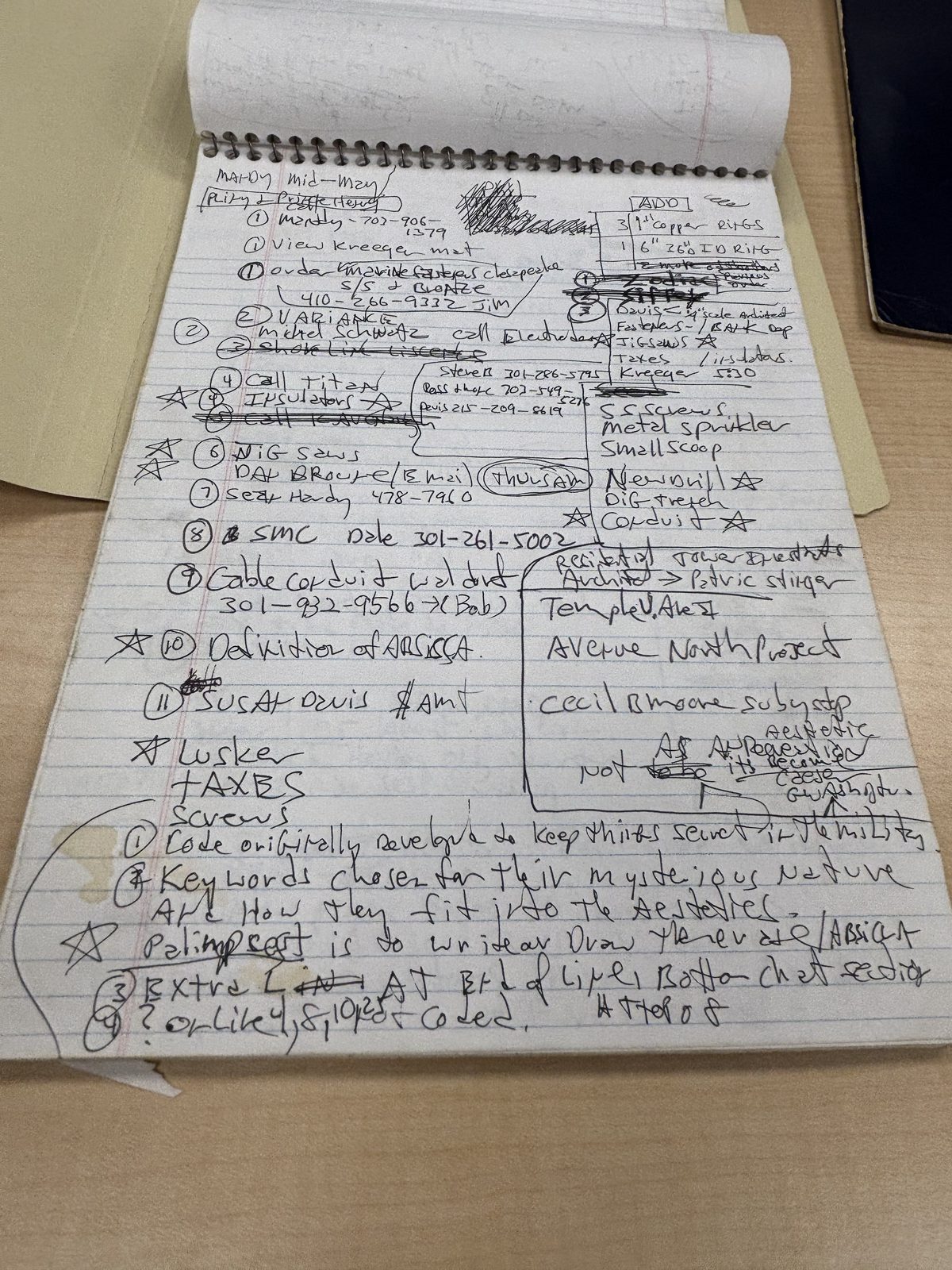
Keyword & Cipher Process Notes
IMG_1340 (CRITICAL DOCUMENT)
A dense notebook page with multiple cryptographically significant elements:
“Code originally developed to keep things secret in the military”
“Keywords chosen for their mysterious nature AND how they fit into the Aesthetics”
“Palimpsest is to wr[ite over]…” / “ABSCISSA”
The bottom of the page contains what appears to be cipher process instructions. The second-to-last line reads: “Extra L at end of line, Bottom chart seeding.” This is notable because the Kryptos Vigenère tableau has a well-known anomaly: row N contains an extra L, creating an H-I-L-L reading down the column. Sanborn's note may refer to this feature directly, or to padding a transposition grid with an L to complete a rectangular layout (97 is prime; adding one character yields 98 = 14 × 7). The last line reads: “? or like 4, 8, 10, 25 (+) coded” followed by additional characters that are too difficult to read with confidence. The numbers remain unexplained. A companion page in the same notebook has “★ Definition of ABSCISSA” as a starred priority item, confirming Sanborn researched this term specifically.
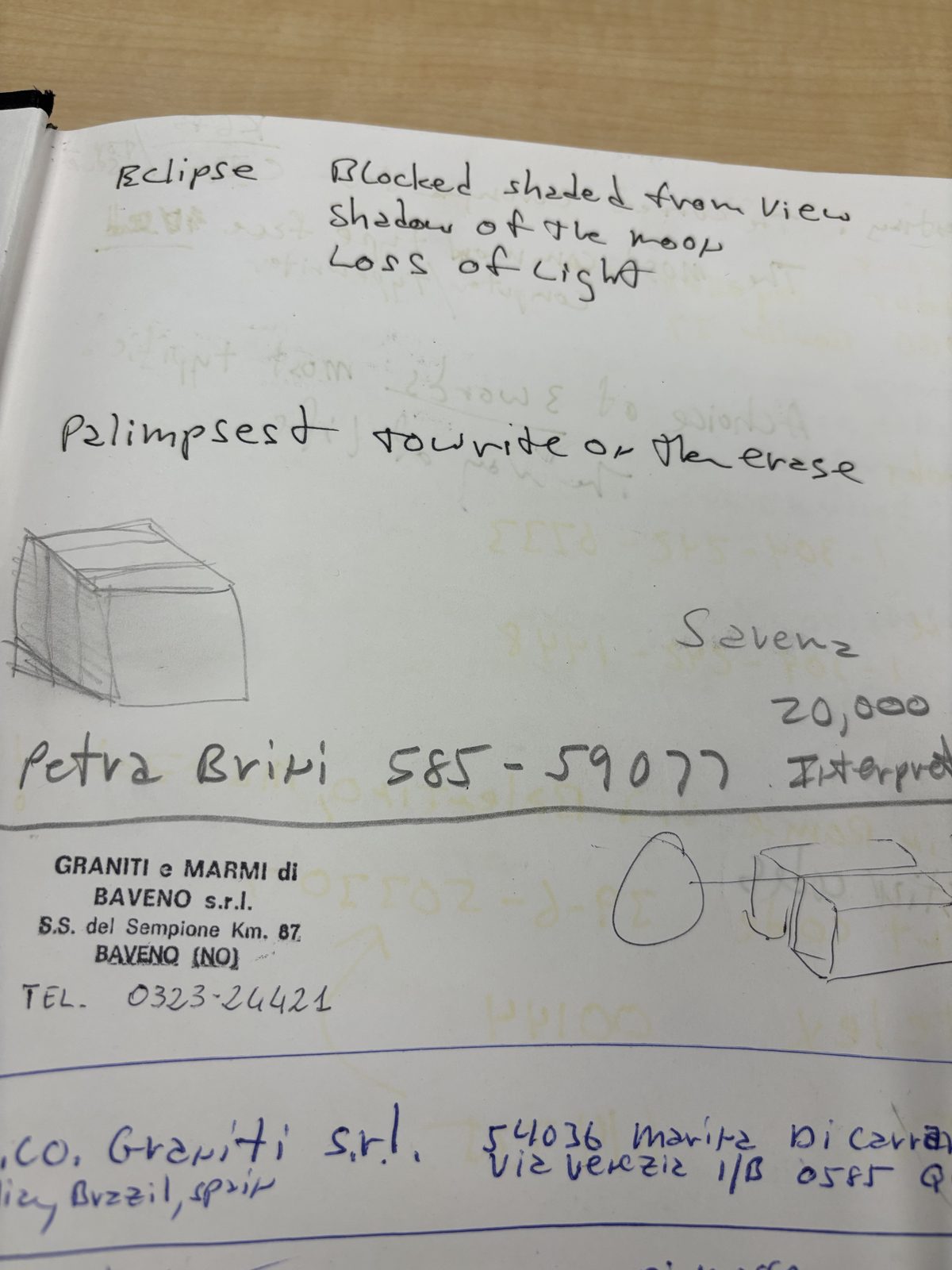
ECLIPSE & PALIMPSEST Defined
IMG_1566
Sanborn defining thematic vocabulary in his own hand:
“Eclipse: Blocked, shaded from view, Shadow of the moon, Loss of Light”
“Palimpsest: to write or to erase”
ECLIPSE could be a keyword candidate or describes the concept of hiding information. “Blocked, shaded from view” maps directly to the steganographic principle described in IMG_1236. The PALIMPSEST definition (“to write or to erase”) emphasizes the overwriting aspect. The page also contains Italian marble supplier contact information (Graniti e Marmi di Baveno), placing these notes in the material sourcing phase.
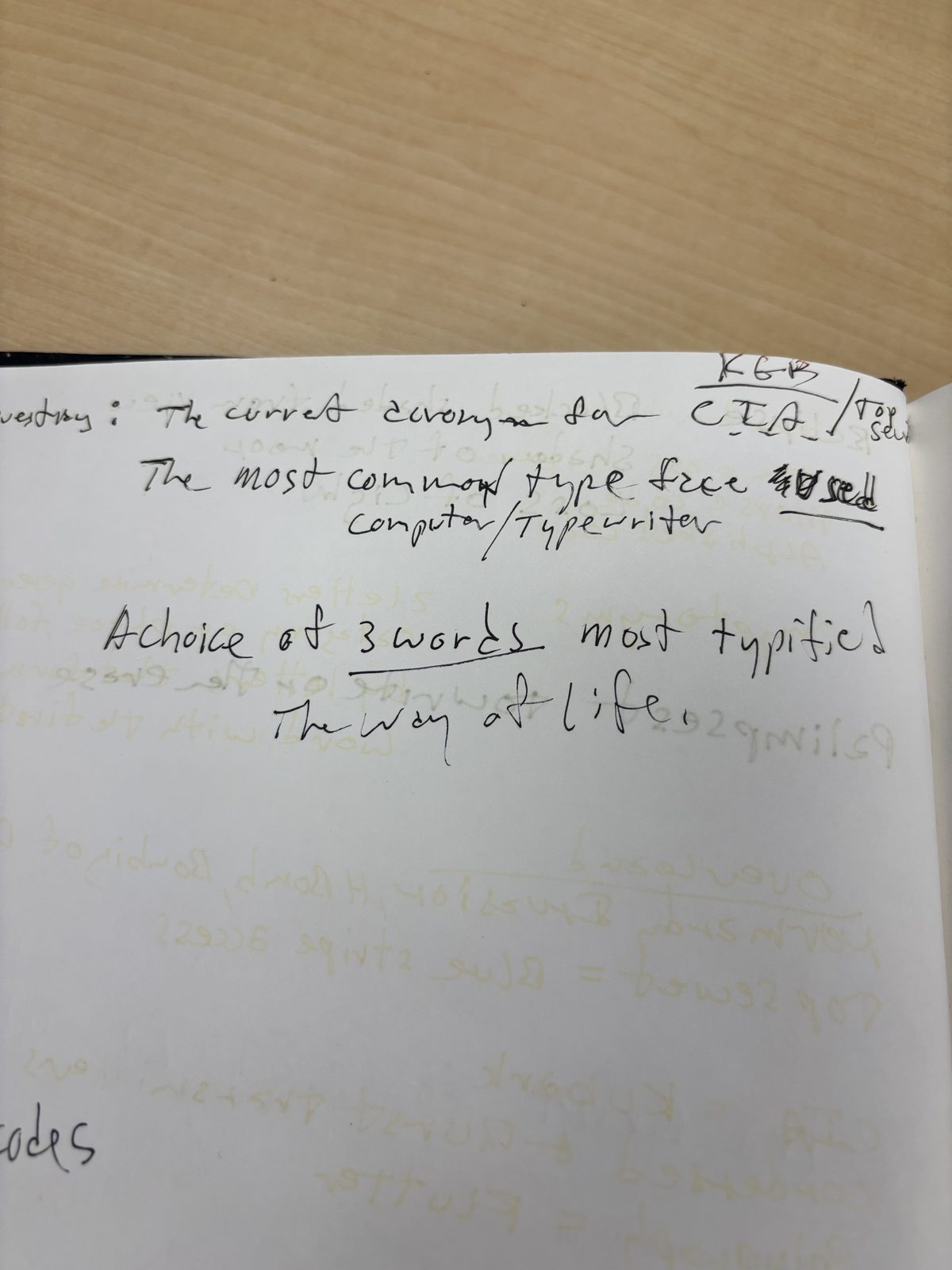
“A Choice of 3 Words”
IMG_1567
In the context of CIA/KGB/Top Secret culture, Sanborn writes:
“A choice of 3 words most typified the way of life”
This could refer to three keywords for the cipher (KRYPTOS, PALIMPSEST, ABSCISSA?), three thematic concepts of espionage, or three words that characterize the intelligence world. The page also references “The current acronym for CIA” / “KGB” / “Top Secret” and “The most common type free [text] / Computer/Typewriter.” Faded pencil text including “Palimpsest” is visible in the lower portion.
3. Cipher Methods & Process Notes
Sanborn's handwritten lists of cipher systems, intelligence terminology, and encoding methods. These reveal what he was taught and what he studied.
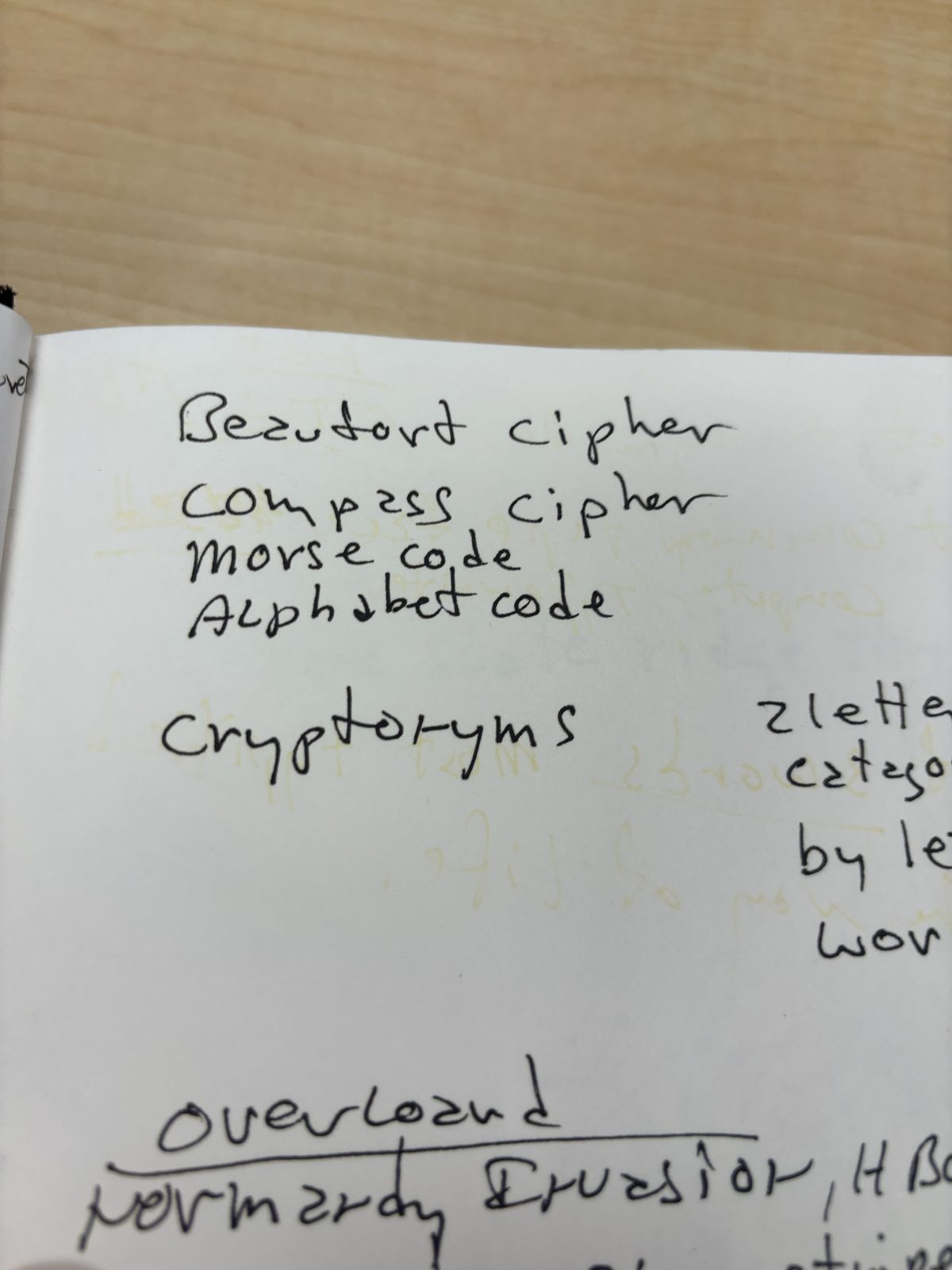
Cipher Types List
IMG_1569
Sanborn's handwritten list of encoding methods:
“Beaufort cipher, Compass cipher, Morse code, Alphabet code”
Below: “Cryptonyms” with a note about how they work (see IMG_1570), then “Overload” (underlined) followed by “Normandy Invasion, H Bo[mb]…” The explicit listing of Beaufort cipher confirms Ed Scheidt taught Sanborn this method (confirmed used in K1–K3). “Compass cipher” may be Sanborn's own term for the compass rose element.
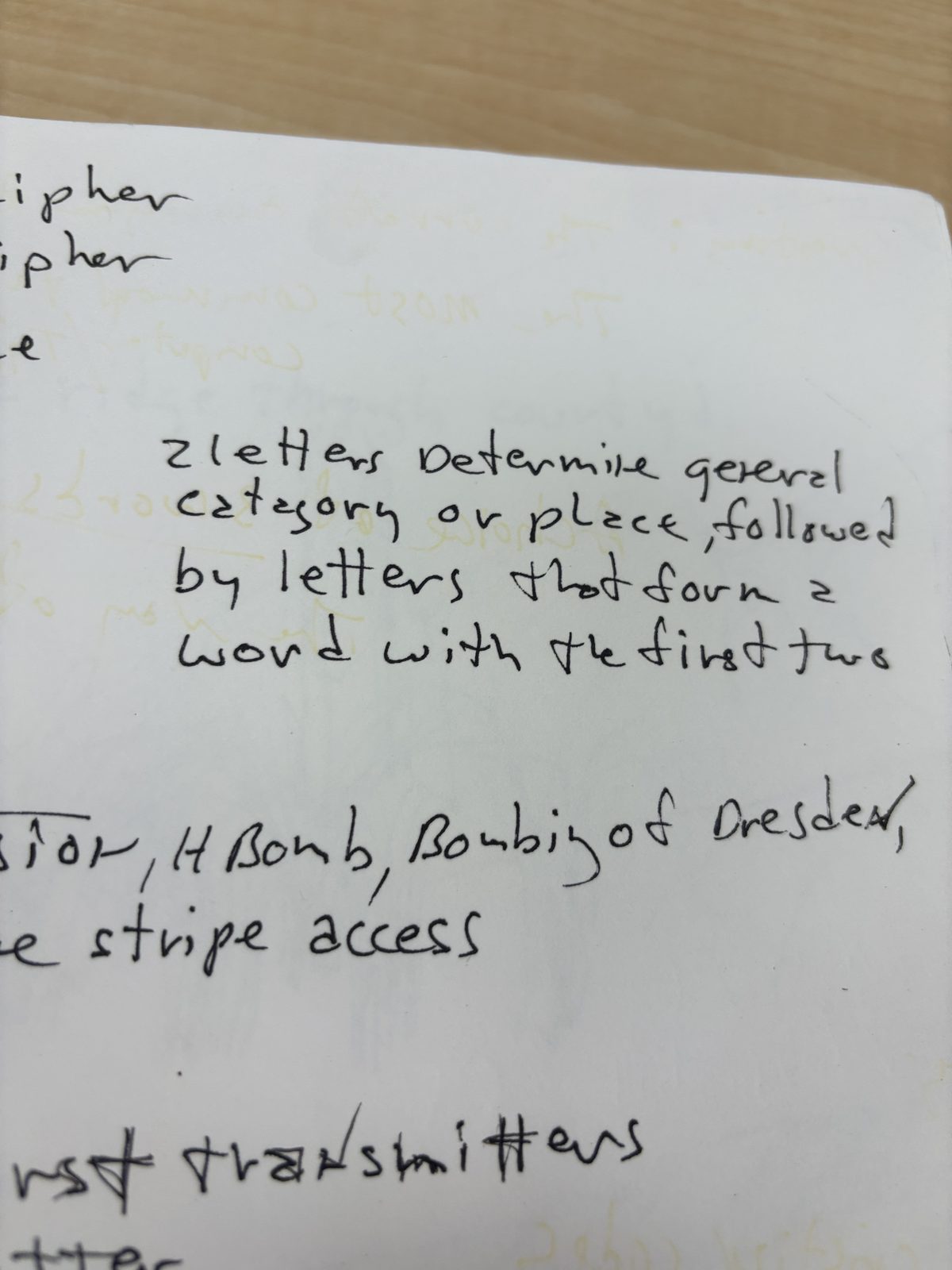
CIA Cryptonym System
IMG_1570
Sanborn's description of how CIA cryptonyms work:
“2 letters determine general category or place, followed by letters that form a word with the first two”
This is a precise description of the cryptonym system (e.g., KU = CIA internal → KUBARK). Also visible: “[Normandy Inva]sion, H Bomb, Bombing of Dresden” and “[Blue] stripe access” (Top Secret classification marking), and “[bu]rst transmitters.”
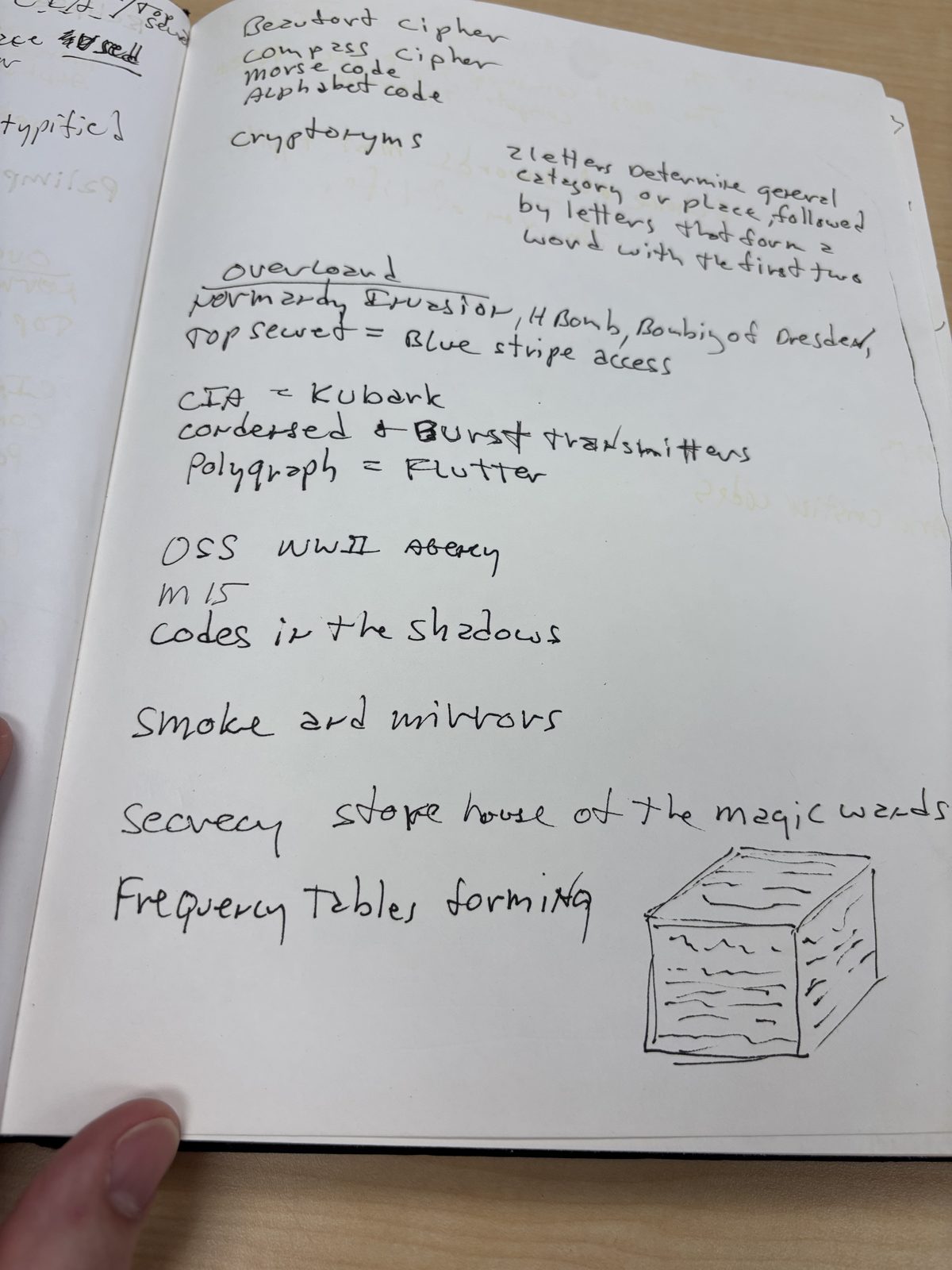
CIA Tradecraft Glossary
IMG_1571
A complete intelligence vocabulary page: “CIA = Kubark” (CIA's own cryptonym), “Top Secret = Blue Stripe Access,” “Polygraph = Flutter,” “OSS WWII Agency” (CIA predecessor), “MI5” (British intelligence), “condensed & burst transmitters” (covert communications), “Codes in the Shadows,” “Smoke and Mirrors,” “Secrecy: store house of the magic wands,” “Frequency Tables forming.” The mention of Frequency Tables shows Sanborn knew about frequency analysis. A sketch of a three-dimensional box appears alongside.
4. Cipher Working Materials & Tableaux
Sanborn's handwritten tableaux, grids, and encoding worksheets. Note: Kryptos uses the Latin alphabet only. Some grids below were created for the separate Cyrillic Projector installation but reveal Sanborn's cipher construction methods.
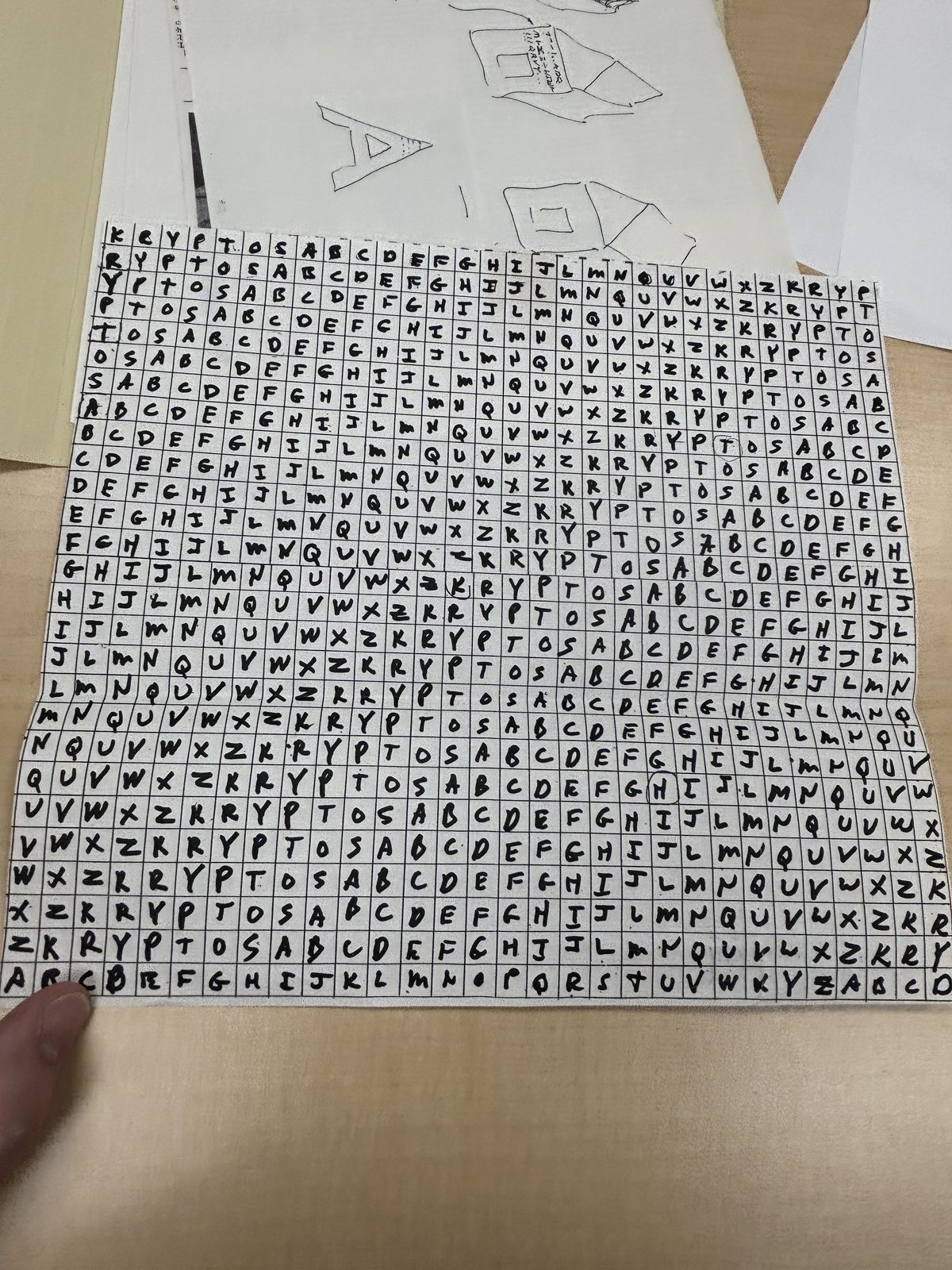
KRYPTOS-Keyed (KA) Vigenère Tableau
IMG_1223
The physical 26×26 Vigenère tableau using the KRYPTOS keyword-mixed alphabet (KA). This is the encryption tableau for K1–K3 (Quagmire III variant). The large letter “A” is visible at top, and a sketch of the sculpture form appears above. The community has long known the tableau structure from cryptanalysis; this is the original working document.
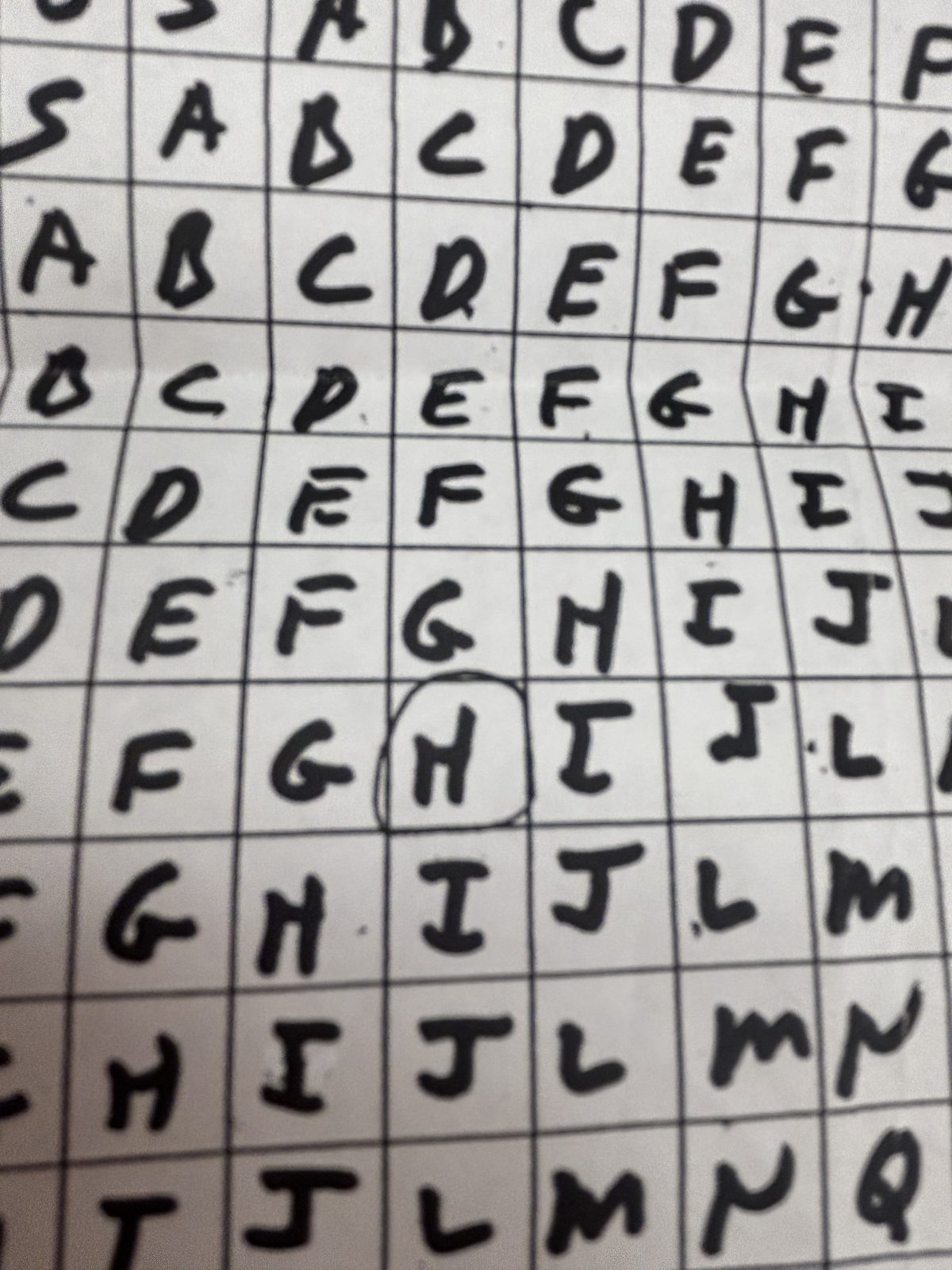
KA Tableau Detail: Circled Letters
IMG_1224
Close-up of the KA tableau showing individual handwritten letters. A circled “H” is visible. Circled letters may mark specific lookup operations performed during encryption.
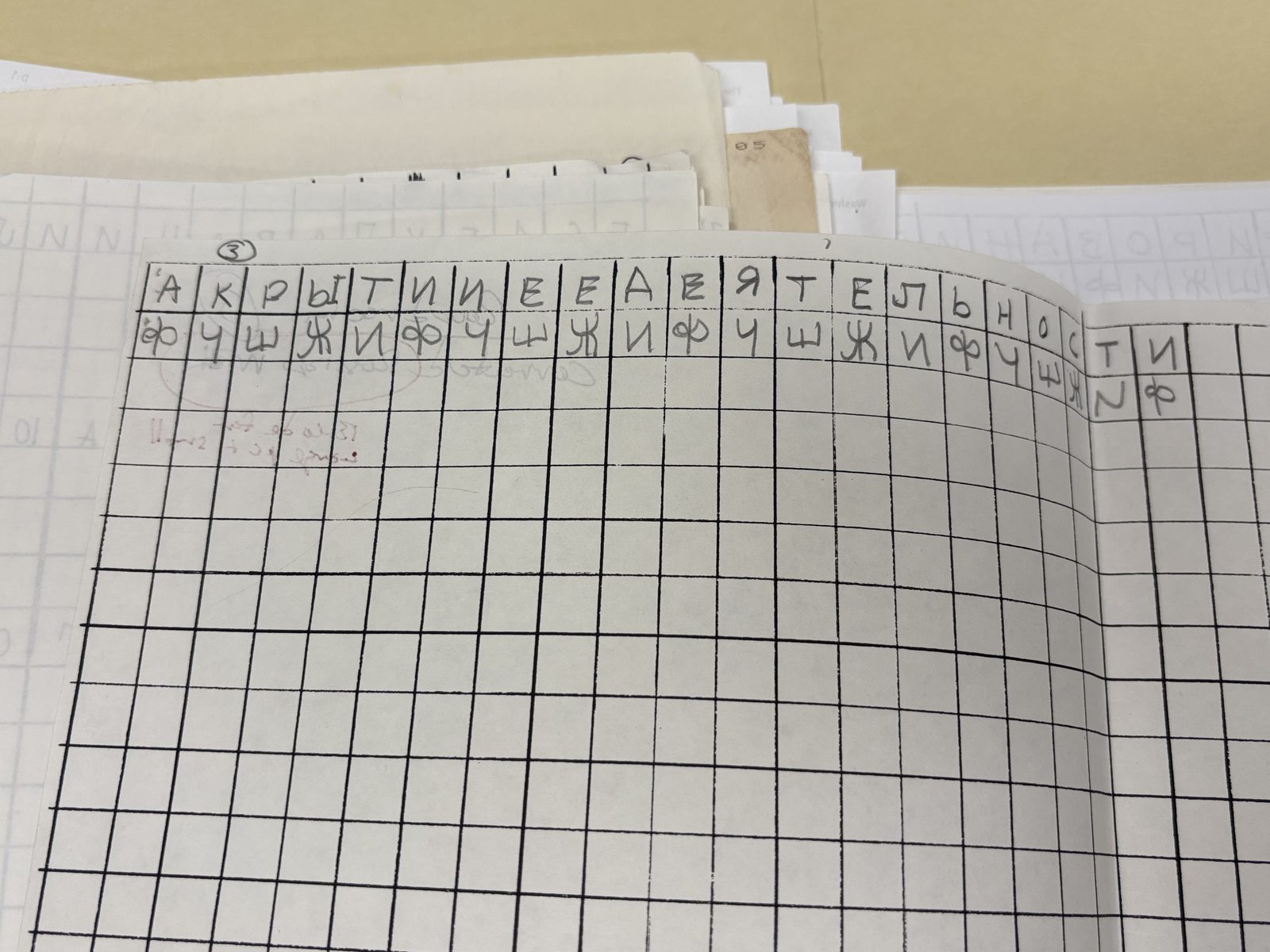
Repeating Key Pattern Grid
IMG_1211
A grid on graph paper with a repeating symbol sequence in the second row. The regularity suggests a cipher key applied cyclically.
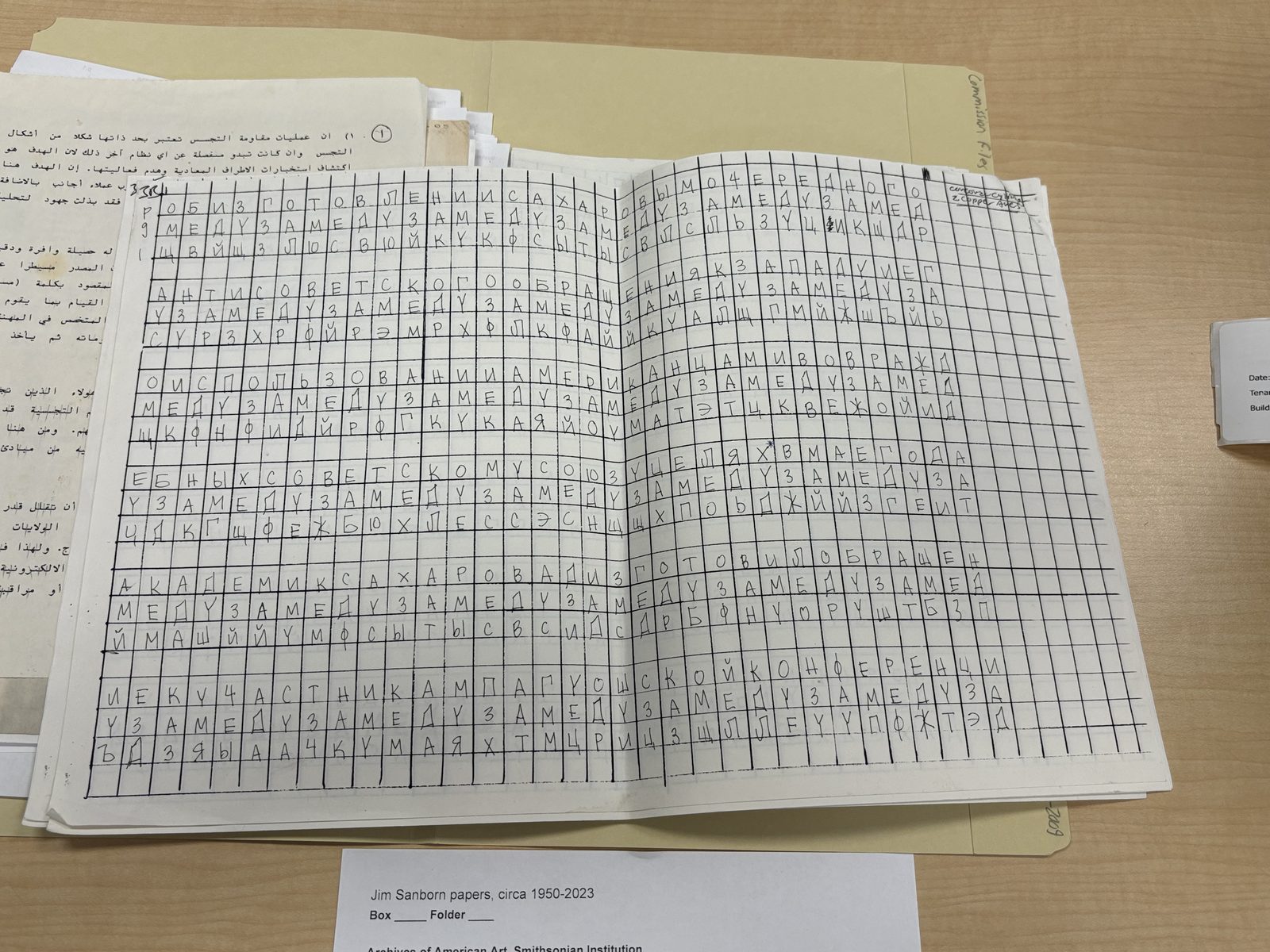
Working Cipher Grid (Mixed Scripts)
IMG_1202
A large working grid with mixed-script entries alongside Arabic source text. Demonstrates Sanborn's multi-script cipher construction methodology.
5. Creation Process & Sanborn's Own Words
Primary source documents in which Sanborn describes his creation process, including working notes and the CIA dedication ceremony transcript (the ceremony speech is publicly available through other sources; the physical document provides context for surrounding annotations).
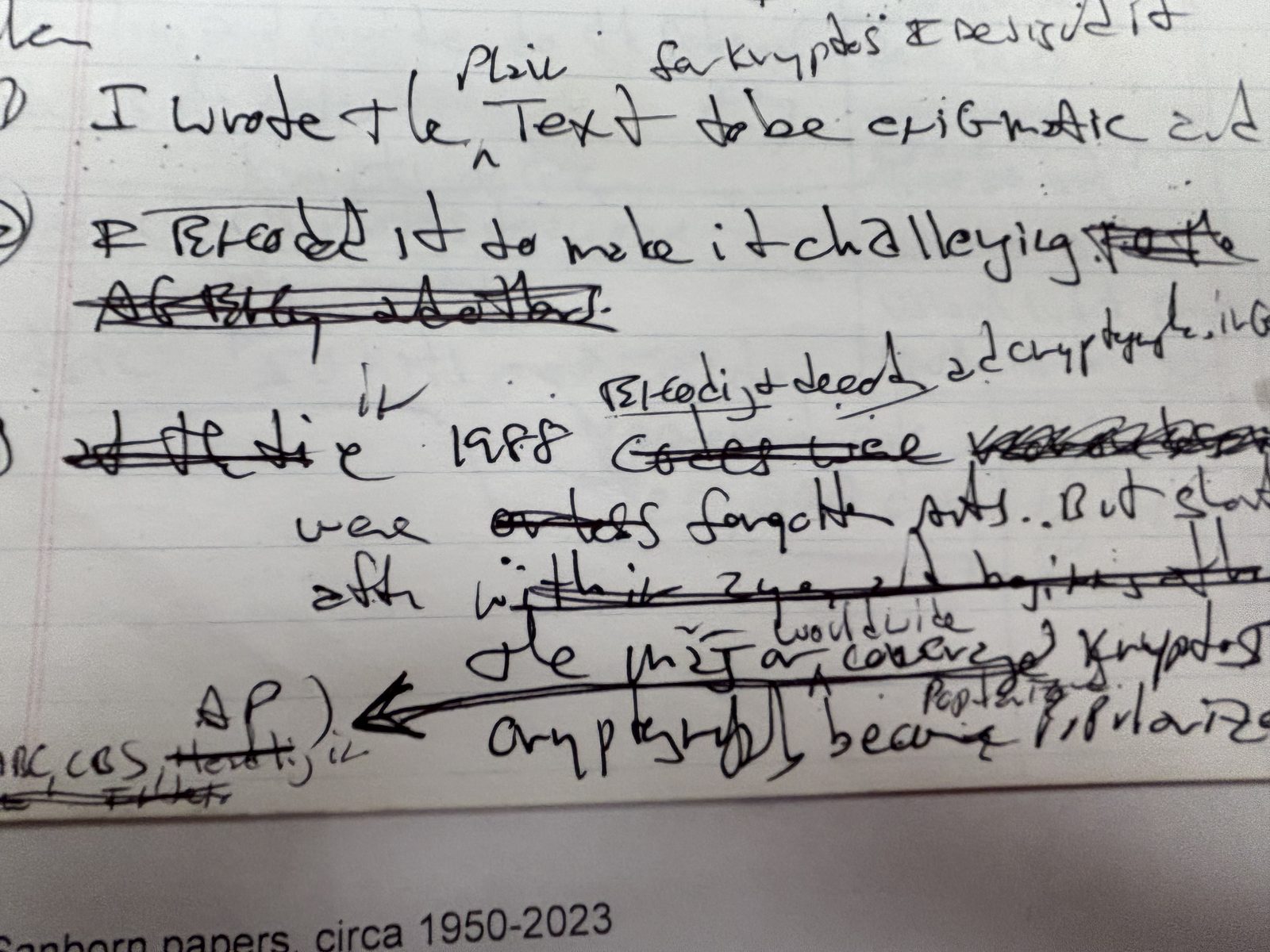
“I Wrote the Plain Text to Be Enigmatic”
IMG_1410
A notebook page (oriented sideways) where Sanborn writes about creating Kryptos. Visible text is consistent with:
“I wrote the… plain… text… to be [deliberately] enigmatic”
This has direct implications for solving K4: the decrypted plaintext will not read as normal English prose. It is intentionally cryptic. Scoring methods that expect high English quadgram scores may need adjustment. Additional text references making the work “challenging” and the year 1988 is visible on the page.
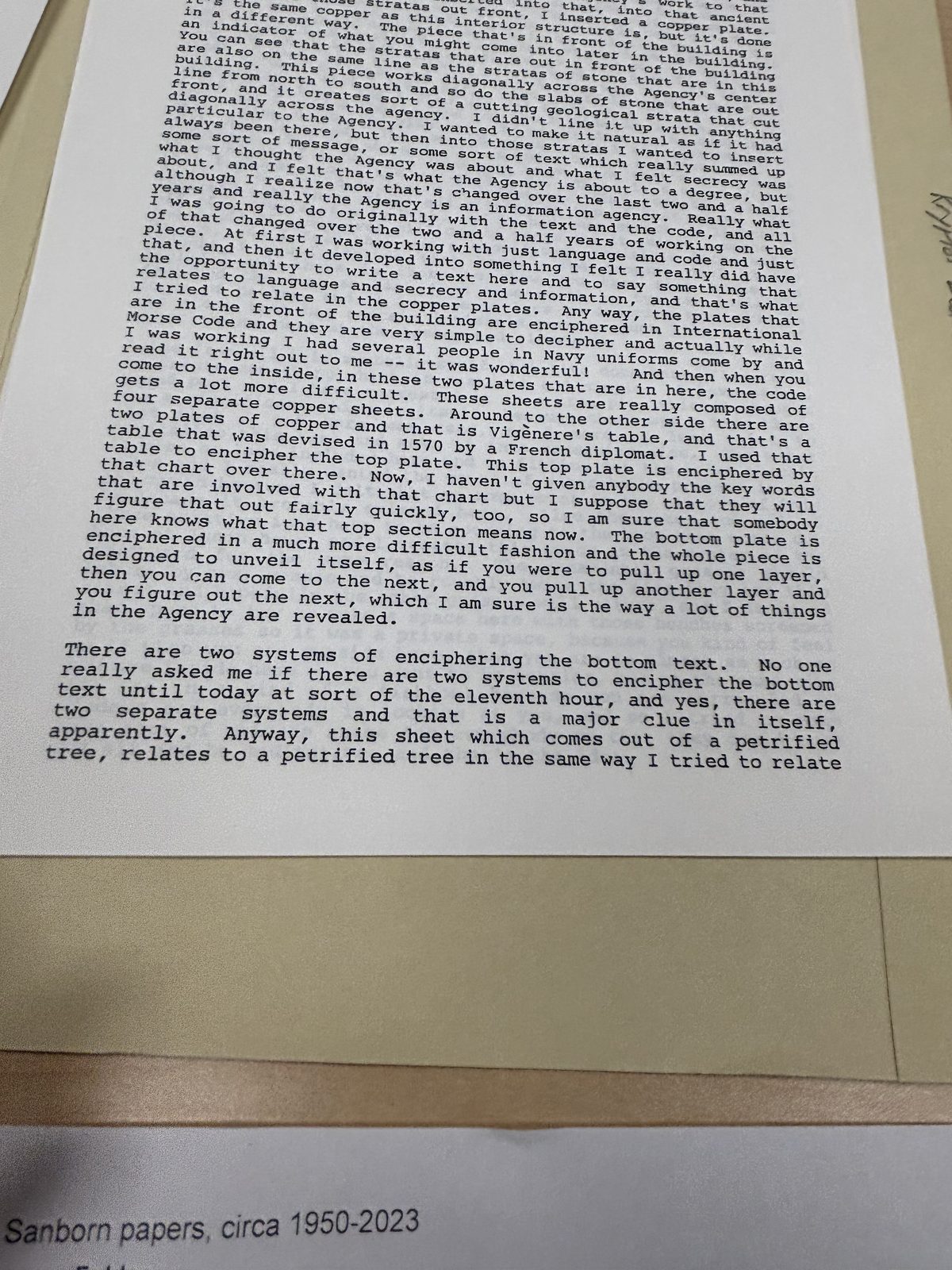
Dedication: “Two Systems of Enciphering”
IMG_1249
From the November 5, 1990 dedication ceremony transcript (this passage is publicly known from other sources). Sanborn states:
“There are two systems of enciphering the bottom text. No one really asked me if there are two systems to encipher the bottom text until today at sort of the eleventh hour; and yes, there are two separate systems and that is a major clue in itself, apparently.”
The physical document provides full context for the surrounding remarks about the petrified tree and installation symbolism. The “bottom text” refers to the lower portion of the copper plate containing K3 and K4.
6. Steganographic Evidence
Documents describing the principle of hiding the real message within a larger set of characters, consistent with the null-mask / Cardan grille model that researchers have hypothesized for K4.
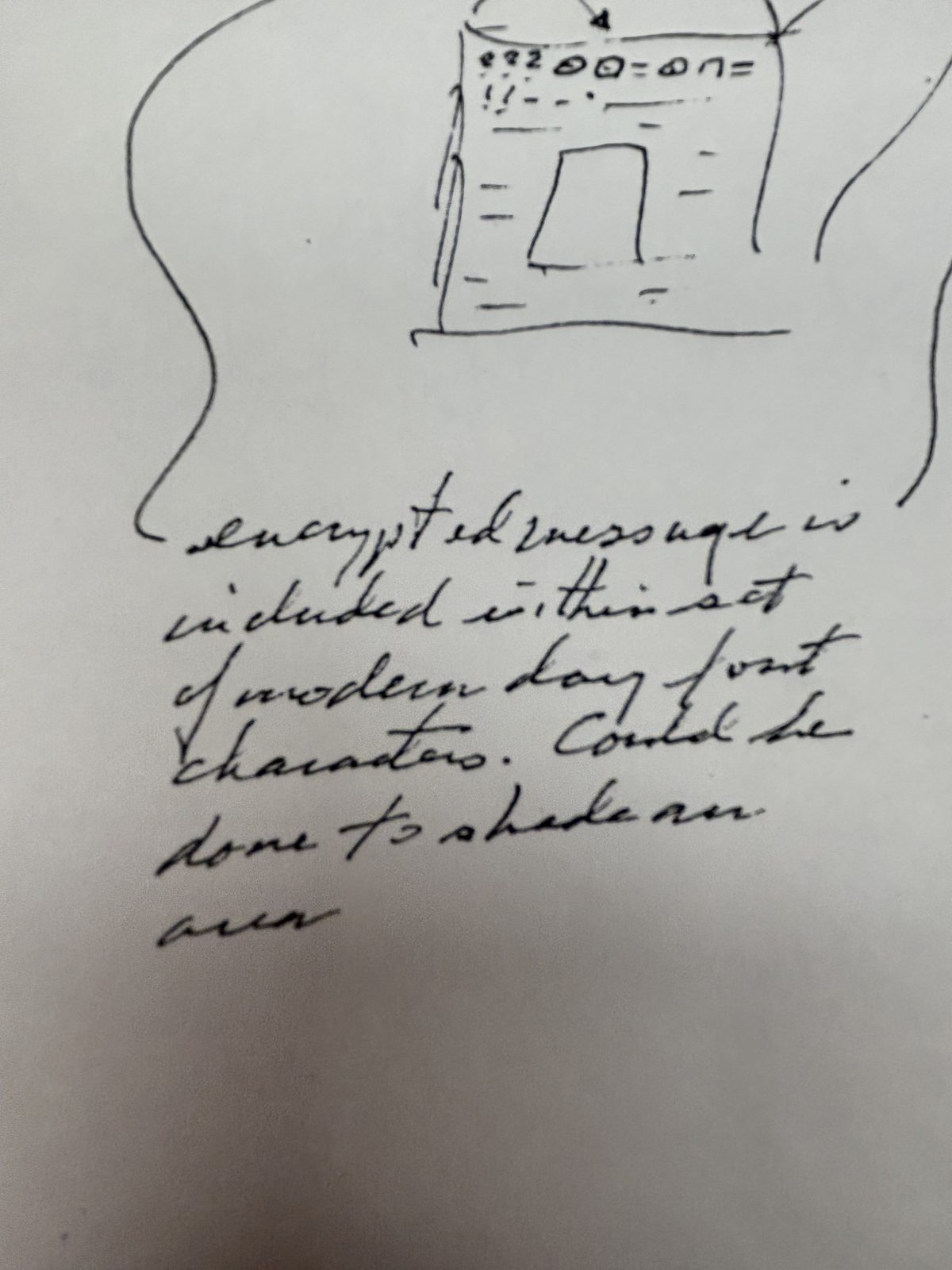
“Encrypted Message Is Included Within…”
IMG_1236 (CRITICAL DOCUMENT)
Sanborn's handwritten description of the Kryptos concept:
“encrypted message is included within set of modern day font characters. Could be done to shade an area”
The encrypted message is hidden within a larger character set, and a physical overlay (“shade an area”) reveals which characters carry meaning. Compare to the ECLIPSE definition in IMG_1566: “Blocked, shaded from view.” A sketch of a sculptural form appears above the text; it is not certain whether this depicts Kryptos or another work.
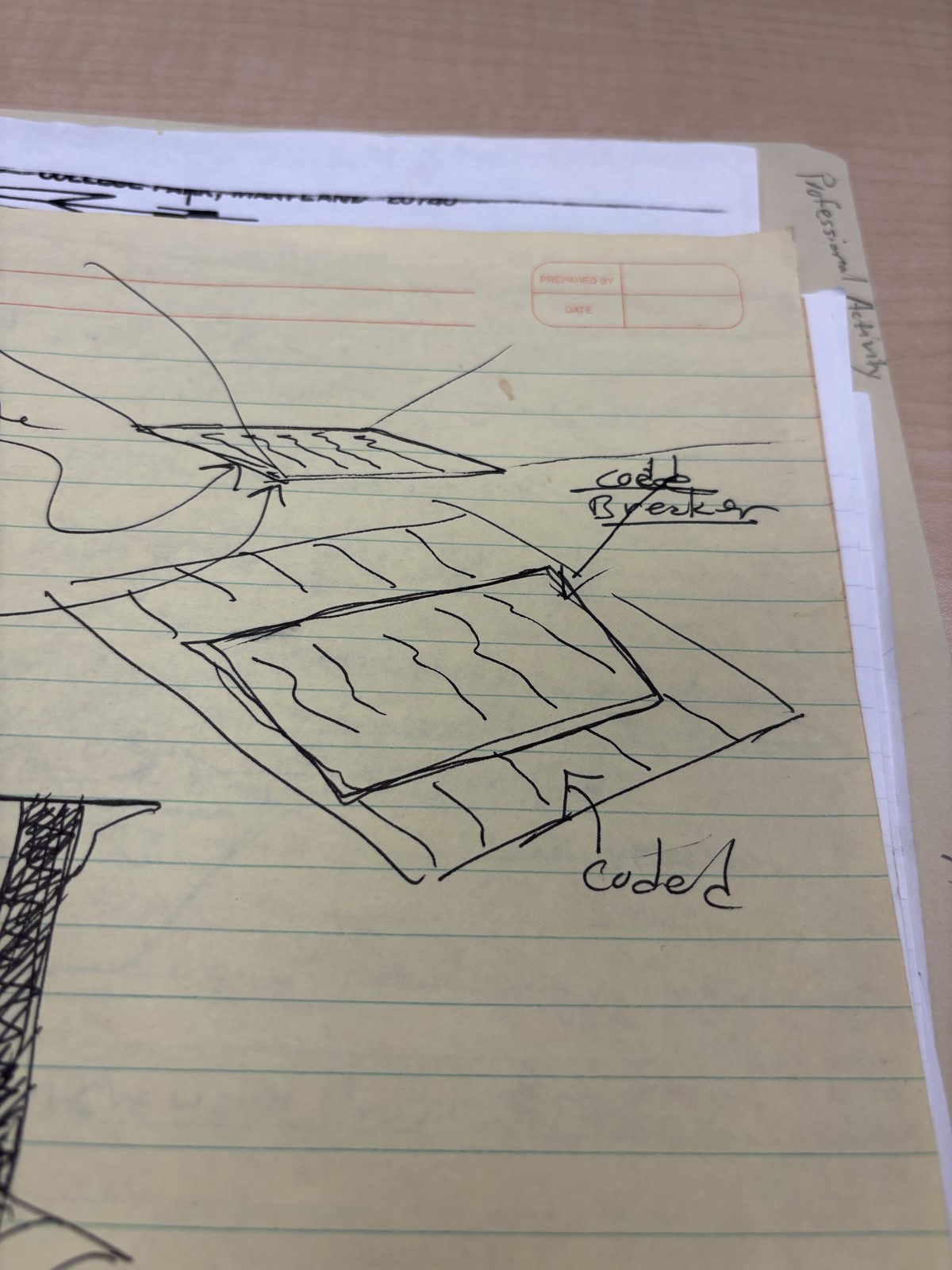
“Code Breaker” Overlay Concept
IMG_1555
A sketch showing a “Code Breaker” template laid on top of the “Code” panel: a physical overlay/grille decryption concept. Combined with “Overlay” in the cipher types list (IMG_1569), this reinforces the Cardan grille / physical mask approach to extracting the message from the ciphertext.
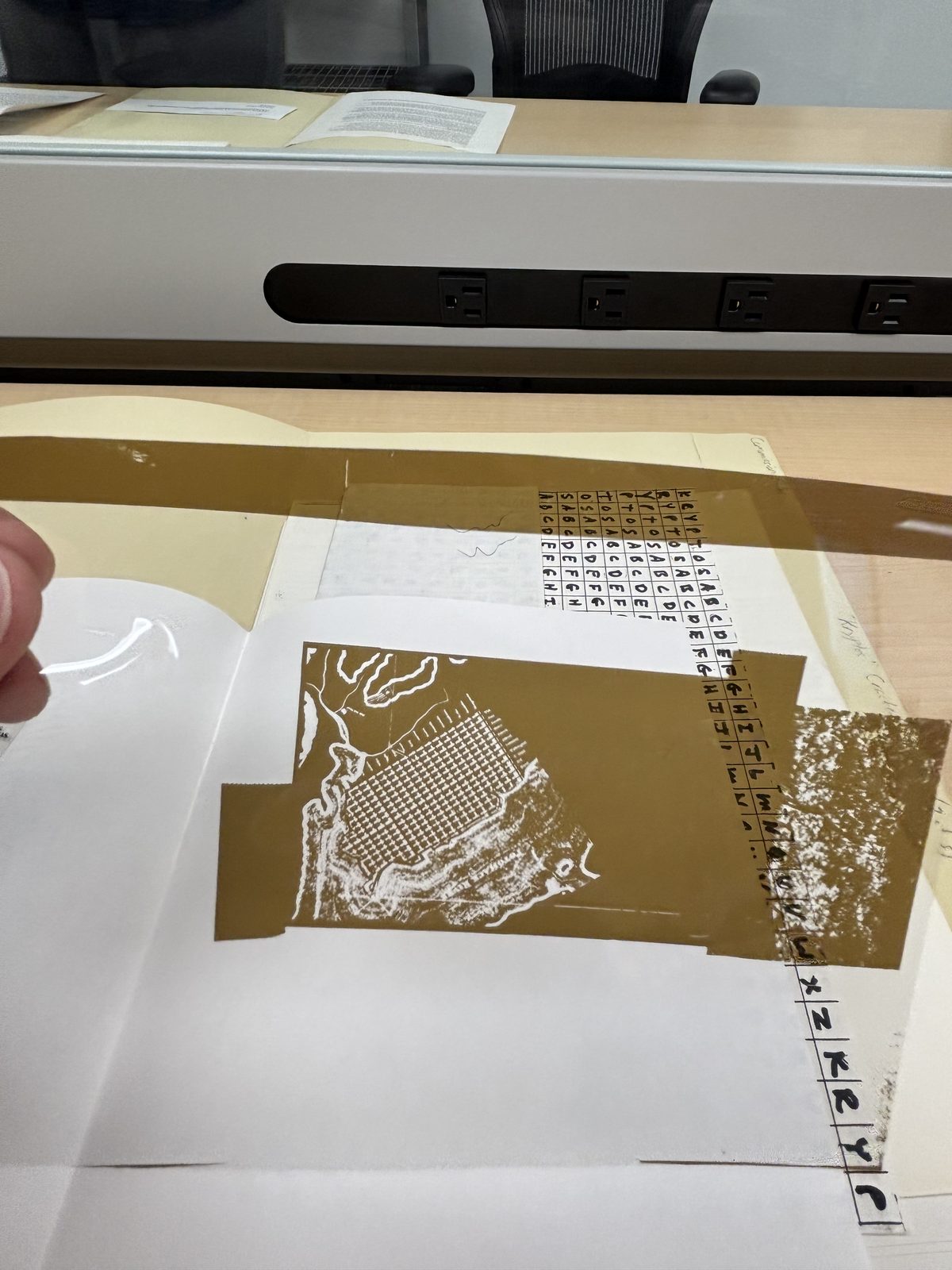
Old Town Alexandria Map Overlay
IMG_1221
A golden/amber transparency showing the street grid of Old Town Alexandria, Virginia, with waterfront features visible. A printed KA tableau is visible beneath it. The pointed landform at the bottom of the map may be Jones Point, the historic survey marker where the first boundary stone of the District of Columbia was placed in 1791. Jones Point has significant surveying and geographic history. A lighthouse was constructed there in 1855. The overlay technique (placing a map on a transparency over cipher materials) may relate to the “shade an area” concept described in IMG_1236.
7. Punctuation & Letterform Anomalies
The Kryptos sculpture contains four question marks at section boundaries. A stencil template in the archive shows an anomaly worth examining.
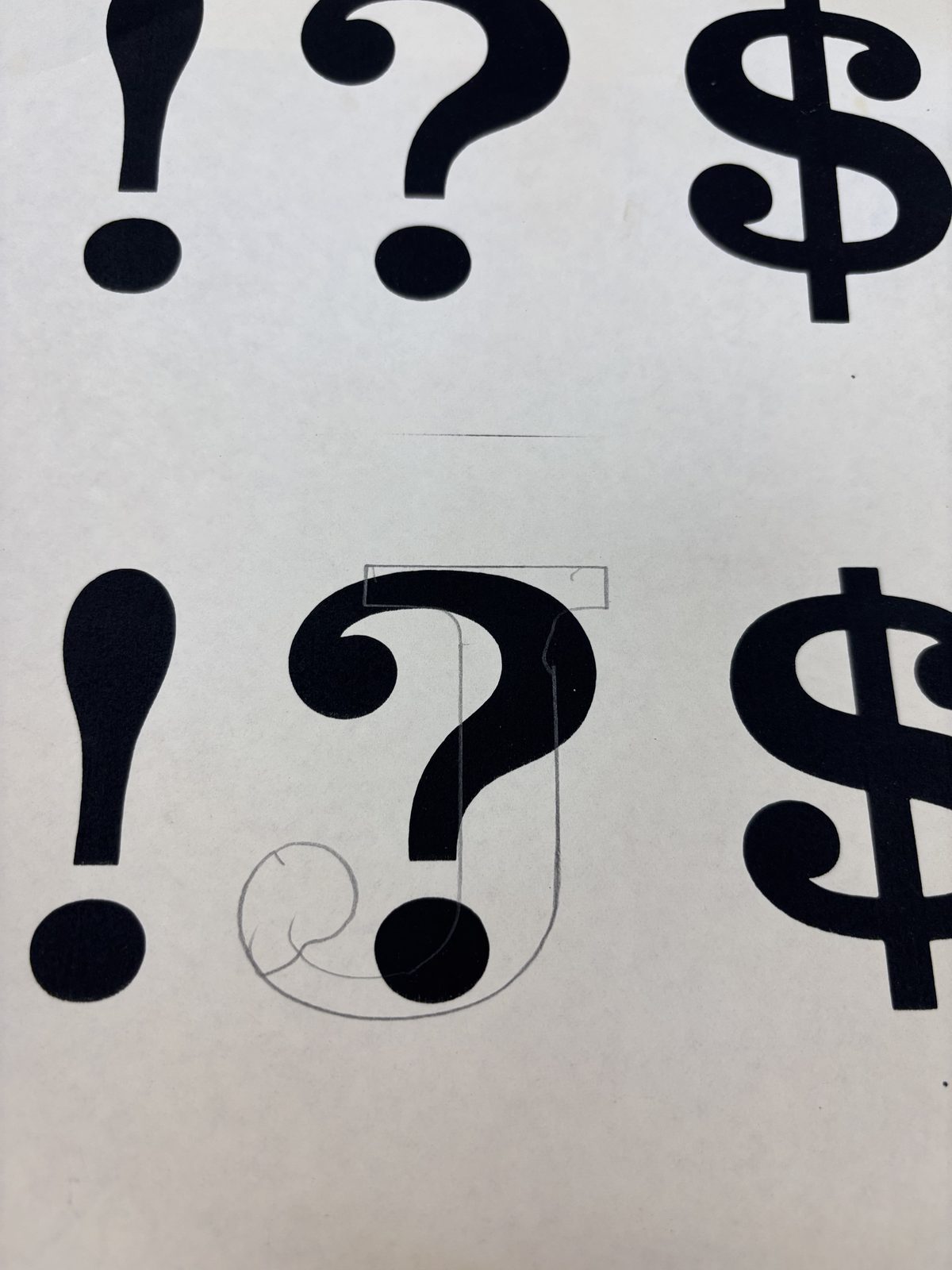
Punctuation Stencil: J Drawn Over ?
IMG_1531 (ANOMALY)
A punctuation stencil template for Kryptos fabrication showing ! ? $ characters. On the bottom row, the question mark has a pencil-drawn J overlaid on it. The J shape wraps around the ? curve with the dot shared. Kryptos has four question marks at section boundaries (between K1/K2, K2/K3, K3/K4, and after K4). If the question marks encode the letter J, this would add hidden characters at section boundaries. The ? between K3 and K4 would be particularly significant.
8. Production, Source Texts & Stencils
Documents related to physical production: stencil orders, waterjet cutting specifications, source texts, and material samples.
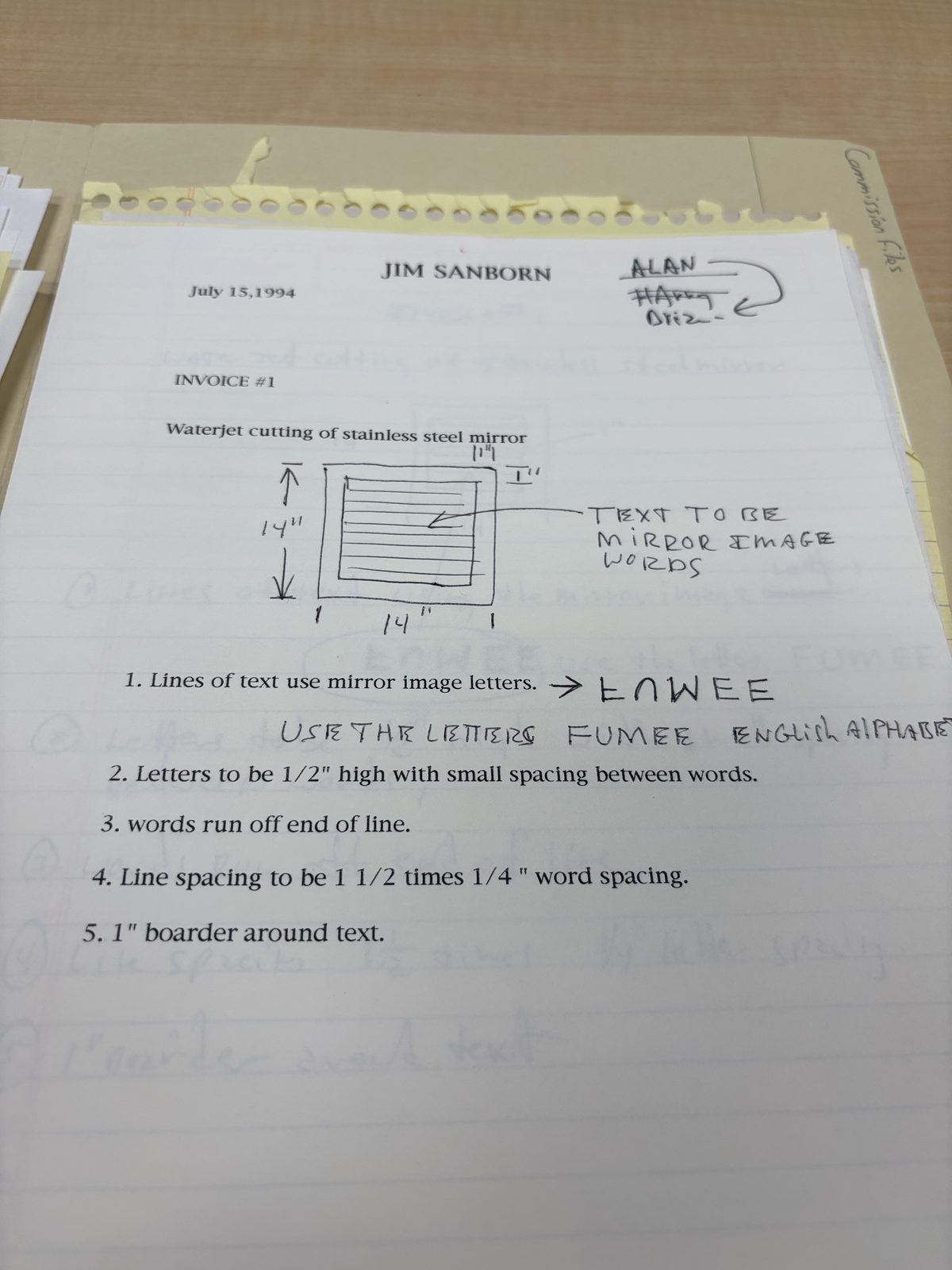
Mirror-Image Waterjet Invoice (July 1994)
IMG_1543
Invoice: “Waterjet cutting of stainless steel mirror.” Key spec: “TEXT TO BE MIRROR IMAGE WORDS” with “EAWEE” shown as mirrored FUMEE. Instruction: “USE THE LETTERS FUMEE ENGLISH ALPHABET.” Confirms Sanborn used mirror-reversed text as a technique. Dimensions: 14″×14″, letters 1/2″ high.
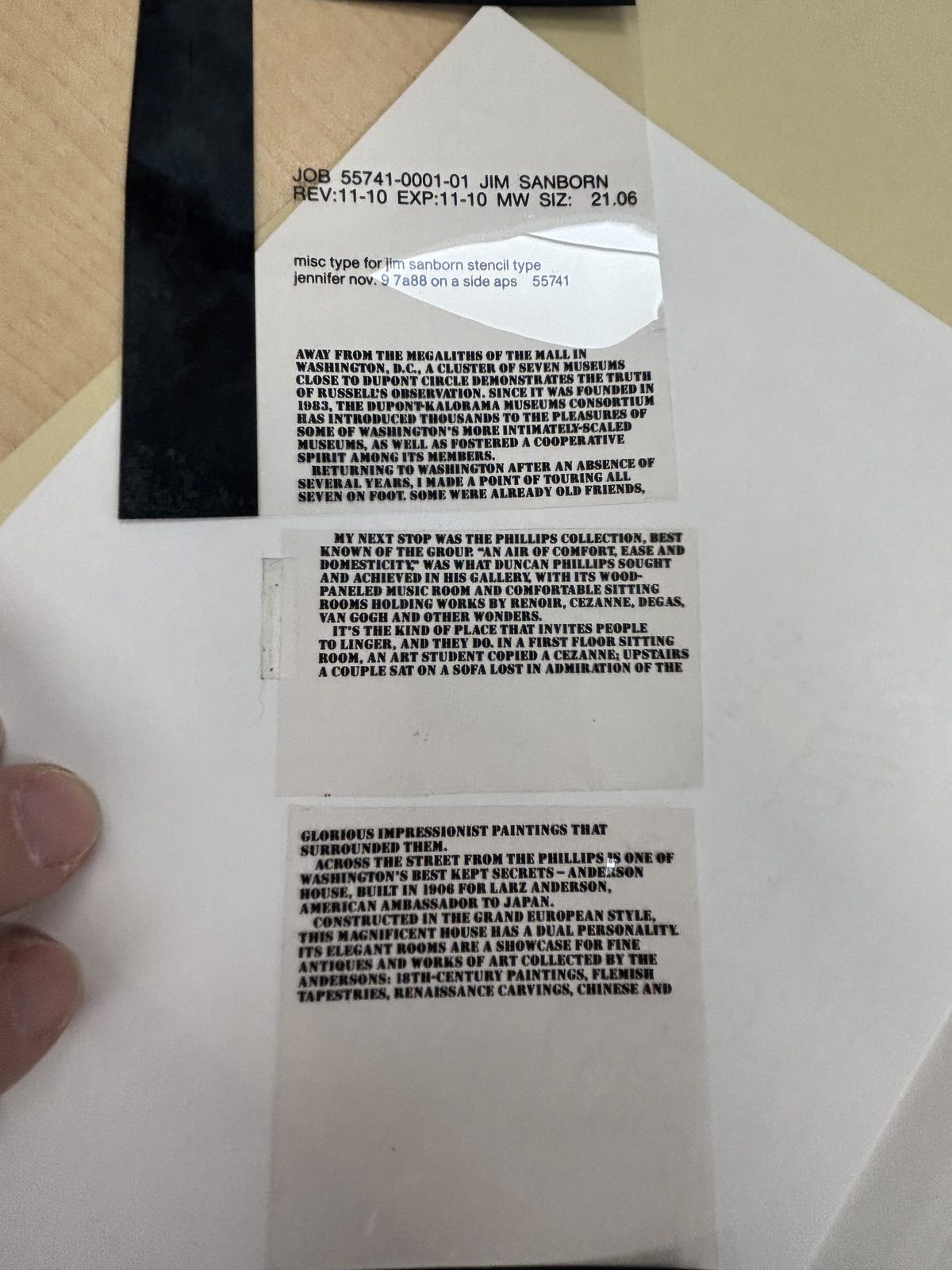
Stencil Job Order (“7×88”)
IMG_1238
Job order specifying “7x88 on a side.” K4 has 97 characters; a 7-row layout is consistent with the sculpture's physical row structure. Phillips Collection and Anderson House source texts visible.
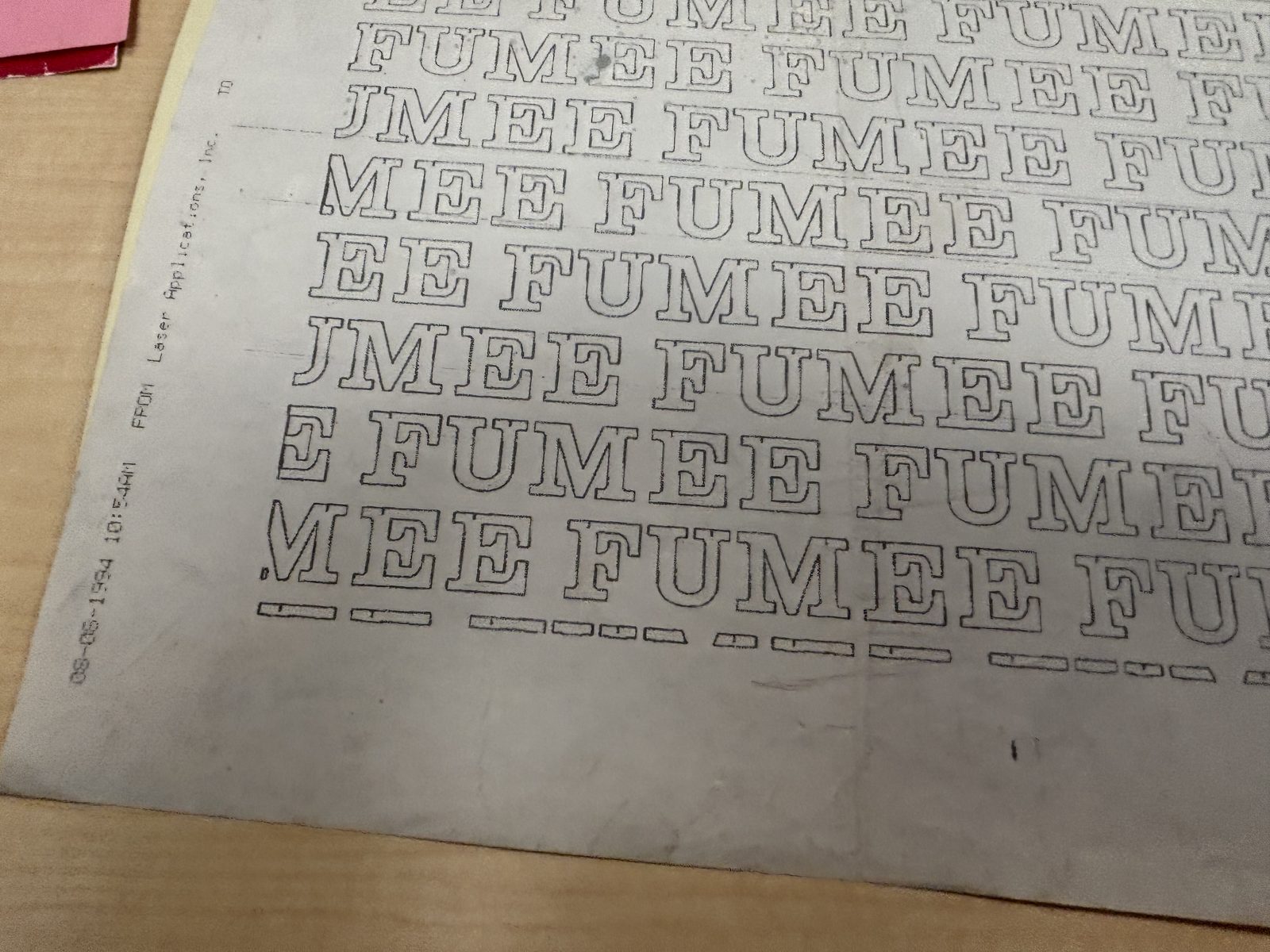
FUMEE Repeating Stencil (Aug. 1994)
IMG_1242
Fax from Laser Applications, Inc. filled with repeating “FUMEE” (French: “smoke”). A stencil cutting proof with thematic fill text resonating with concealment themes.
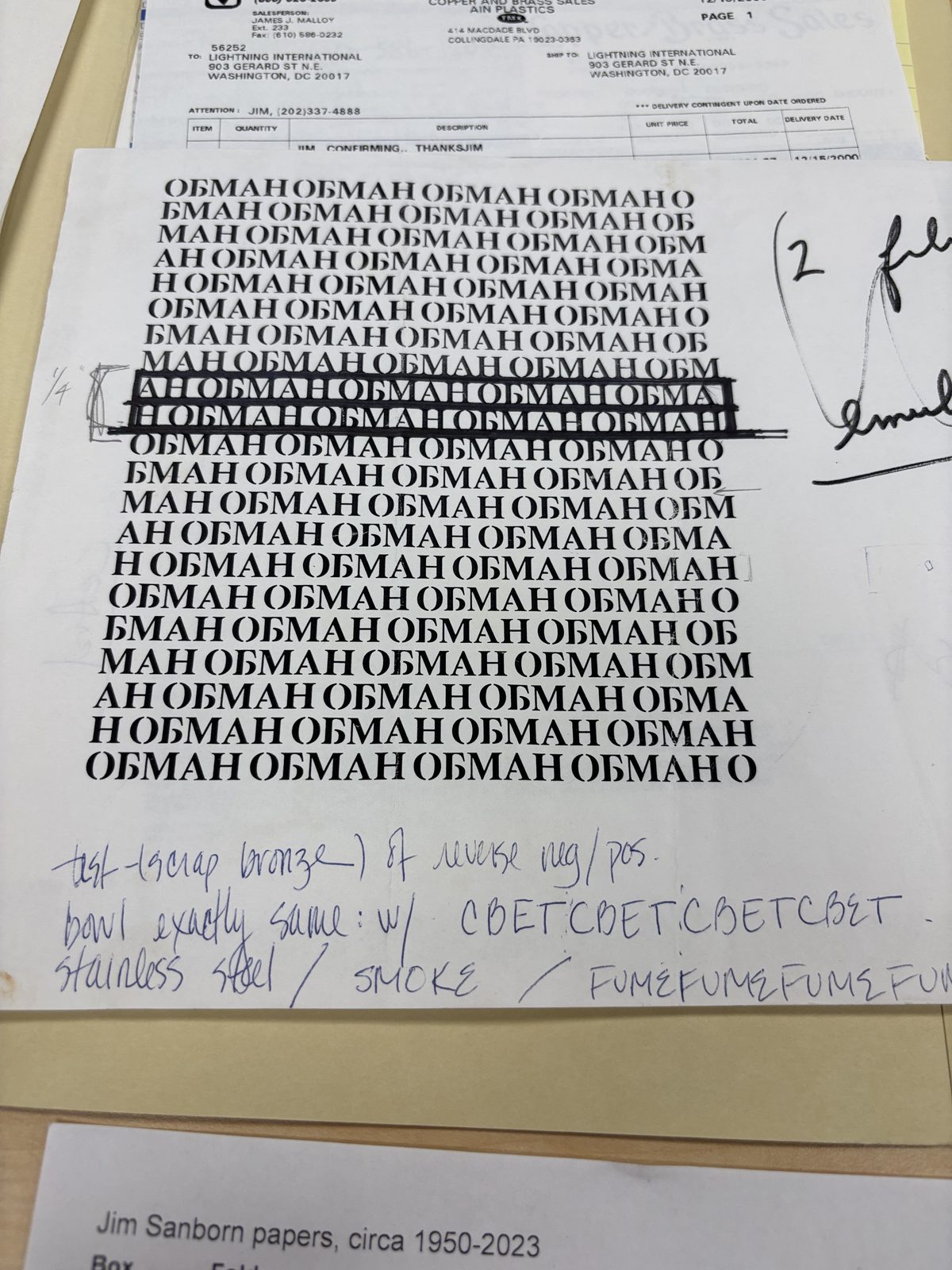
“OBMAN” (Deception) Repeating Text
IMG_1540
Stencil sheet with repeating Russian “ОБМАН” (OBMAN = “deception”). Handwritten notes: “bowl exactly same,” “SVET” (light), “FUME.” Deception as fill text alongside smoke.
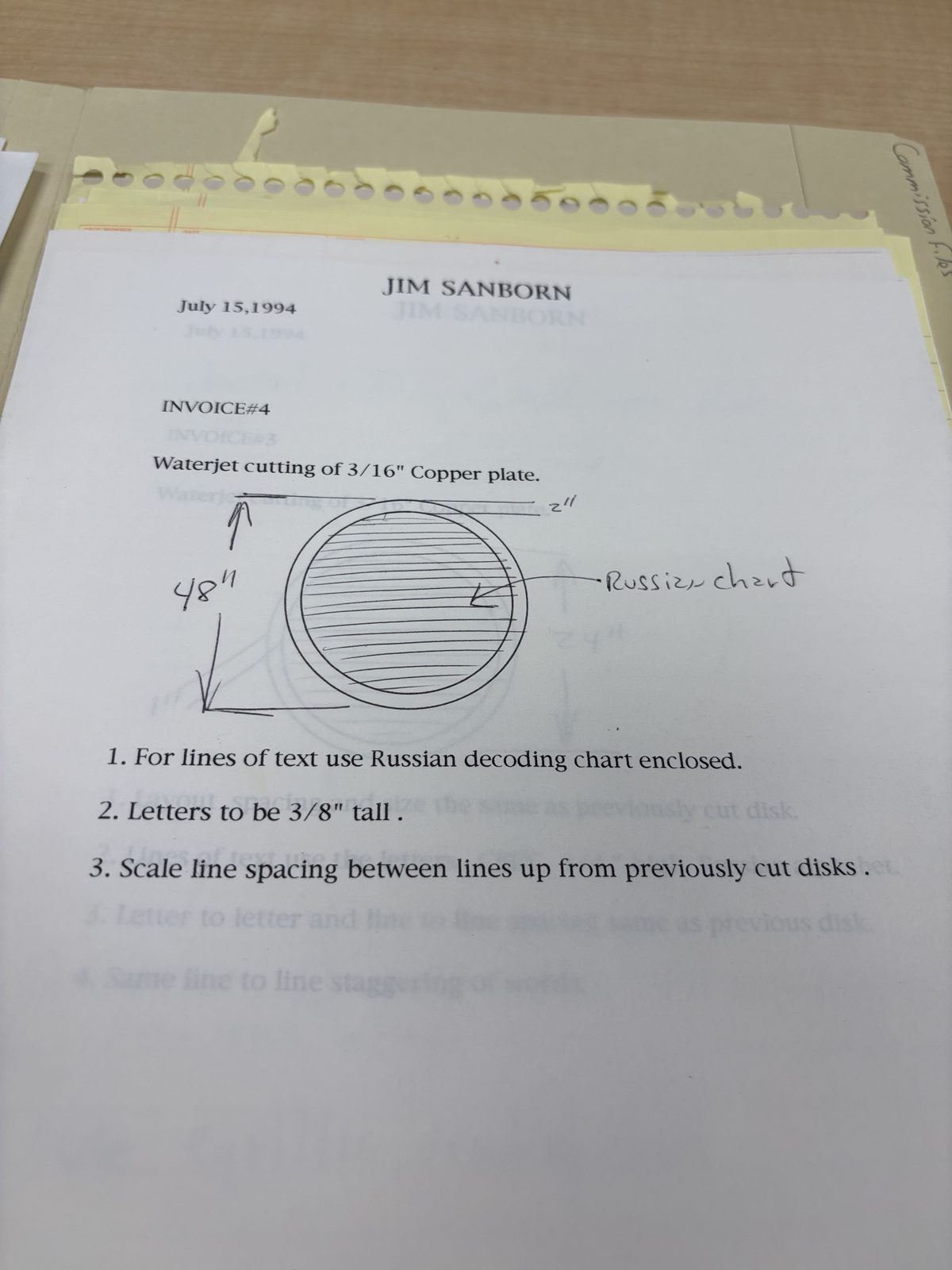
Waterjet Invoice: Copper Plate
IMG_1541
July 1994 invoice: “Waterjet cutting of 3/16″ Copper plate,” 48″ diameter, “For lines of text use Russian decoding chart enclosed.”
9. Navigation & Color Symbolism
Sanborn's detailed study of junction buoys, navigation markers, and port/starboard color systems. The Kryptos color scheme (green copper patina, red granite, blue water pool) maps to navigation colors. Junction buoys mark bifurcations: choosing which path to take.
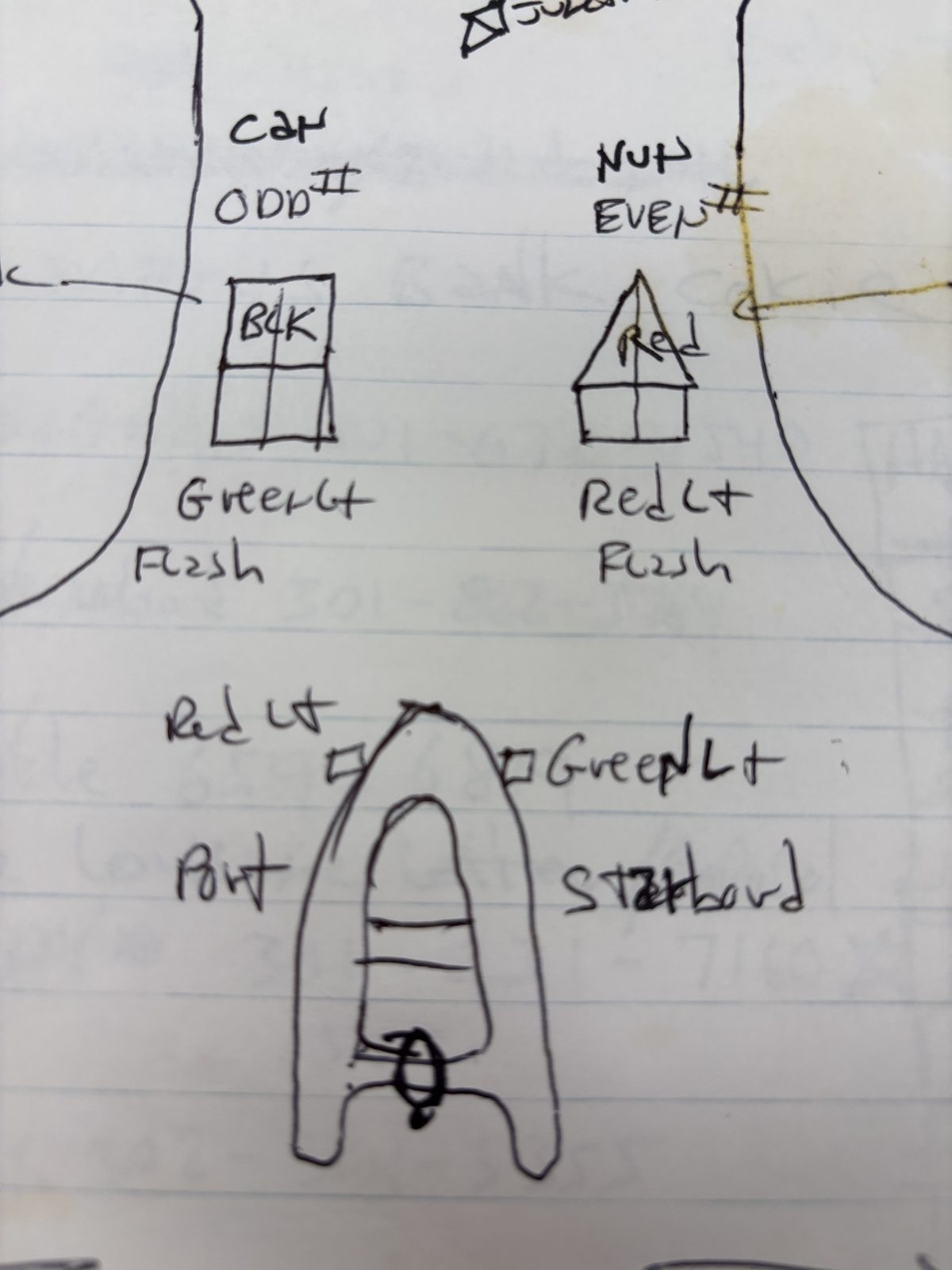
Junction Buoy Study
IMG_1428
Detailed study of junction buoys (bifurcation buoys): Left: “CAN ODD#” (Black buoy, Green Light Flash). Right: “NUN EVEN#” (Red buoy, Red Light Flash). Below: boat diagram with Port (Red Lt) and Starboard (Green Lt). Junction buoys mark a bifurcation: choosing which channel to take. The arrow patterns resemble coding chart conventions.
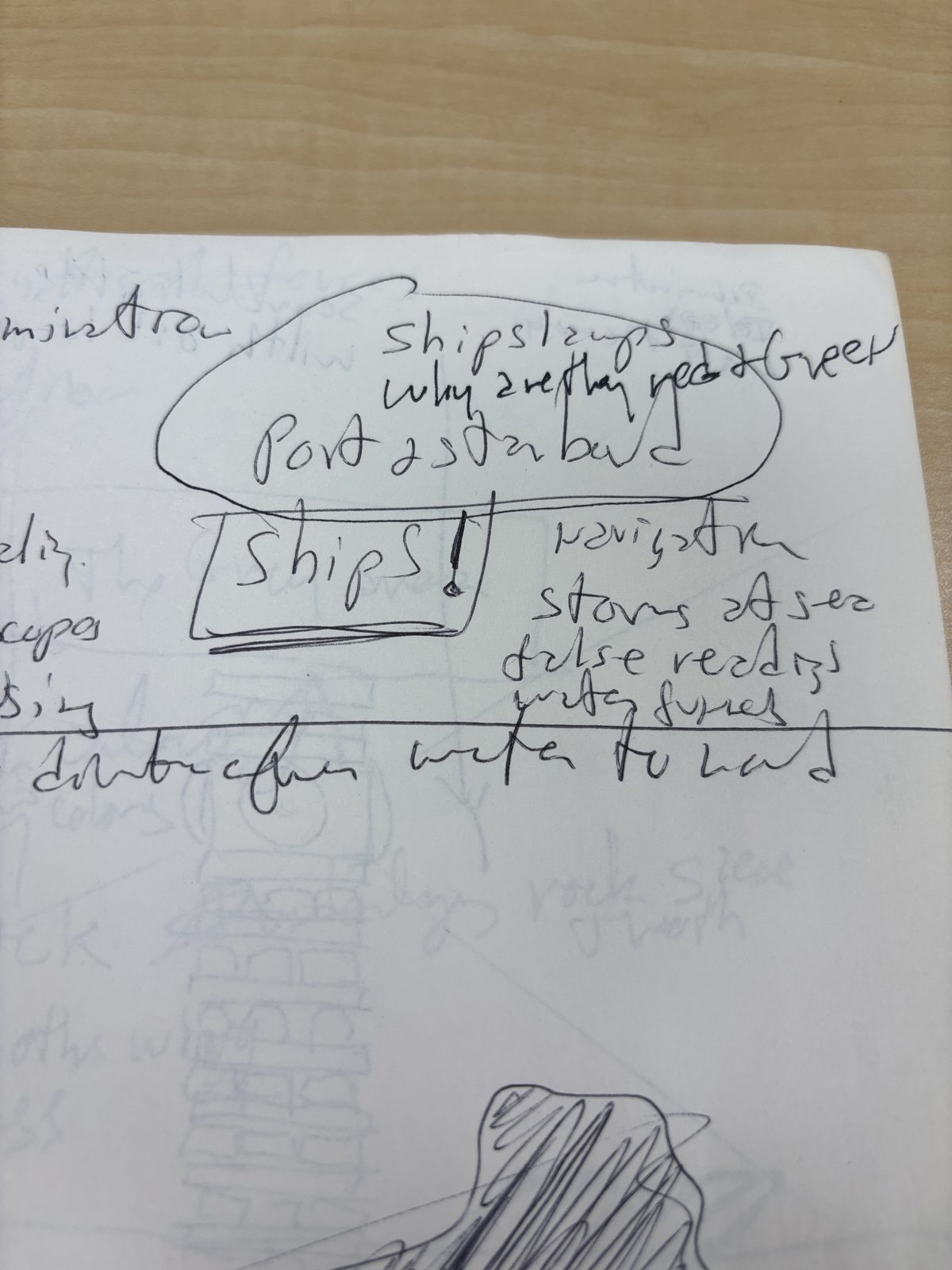
“Ships! Why Are They Red & Green”
IMG_1614
Sanborn's notes: “Ships!” “Why are they Red & Green,” “Port & Starboard,” “Navigation,” “Storms at Sea,” “false readings,” “uncharted.” The green (copper patina) and red (granite) of the Kryptos installation map directly to navigation port/starboard colors. “False readings” resonates with the cryptographic concept of misleading signals.
10. Concept, Design & Themes
Conceptual notes, coordinate work, thematic brainstorming, and design sketches revealing the intellectual framework behind Kryptos.
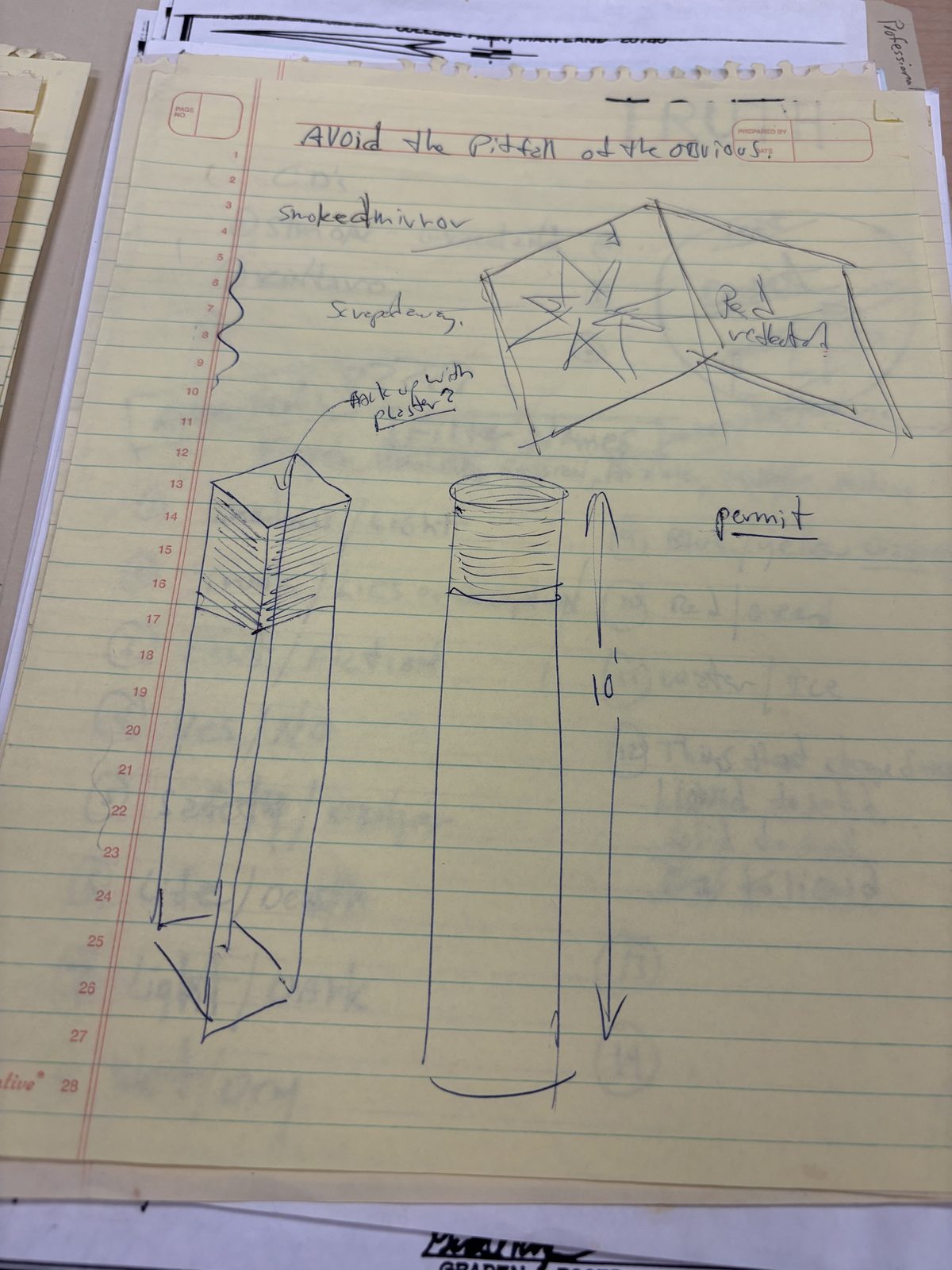
“Avoid the Pitfall of the Obvious”
IMG_1560
Sanborn's design maxim. Below: sketches of sculptural forms including a cylinder and star/compass element.
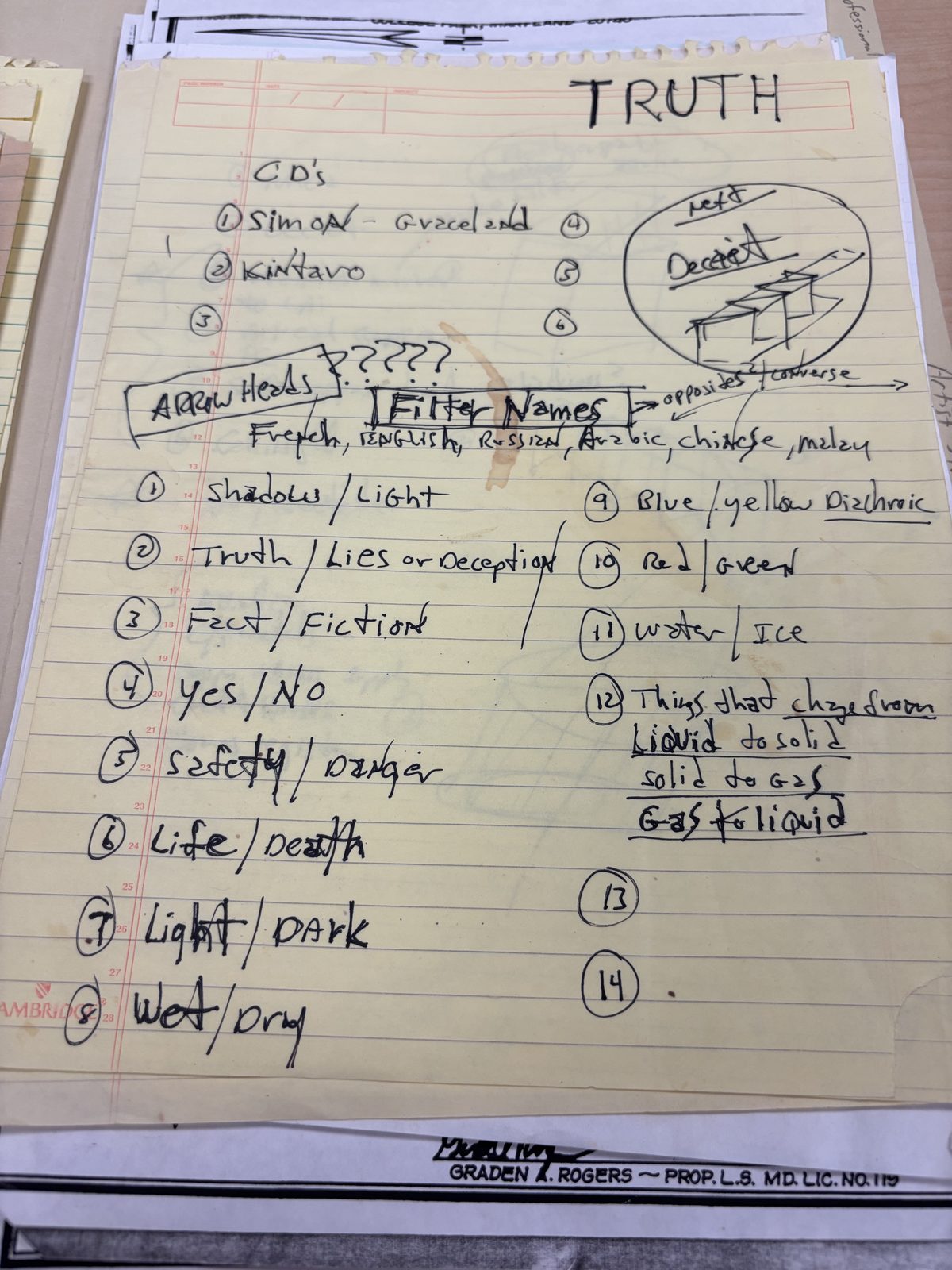
“TRUTH” Thematic Pairs
IMG_1561
Dichotomy pairs: Shadow/Light, Truth/Lies, Fact/Fiction, Life/Death, Light/Dark, Blue/Yellow Dichroic, Red/Green. Also: “Filter Names: French, English, Russian, Arabic, Chinese, Malay.”
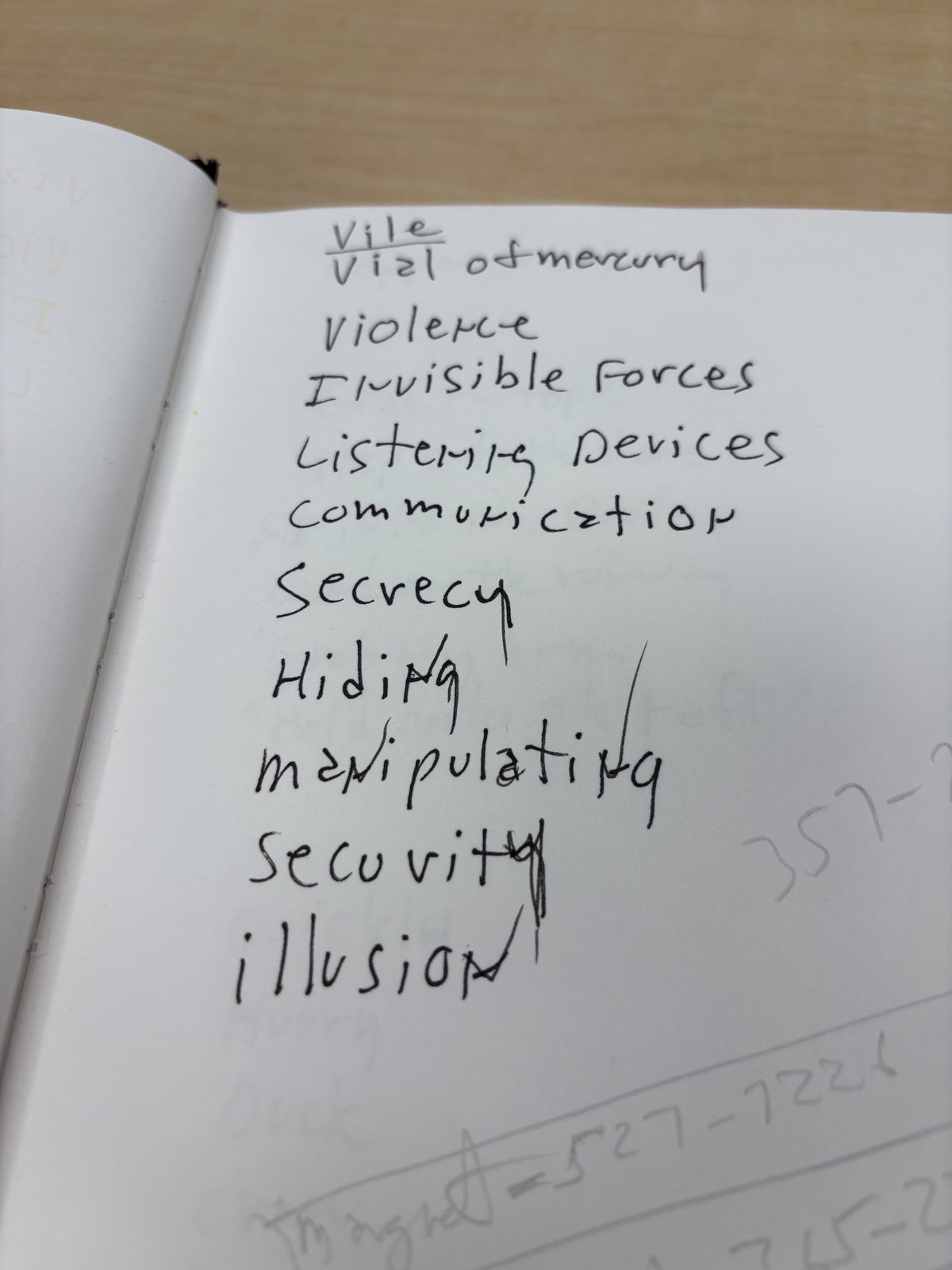
Thematic Word List
IMG_1574
“Invisible Forces, Listening Devices, Communication, Secrecy, Hiding, Manipulation, Security, Illusion.”
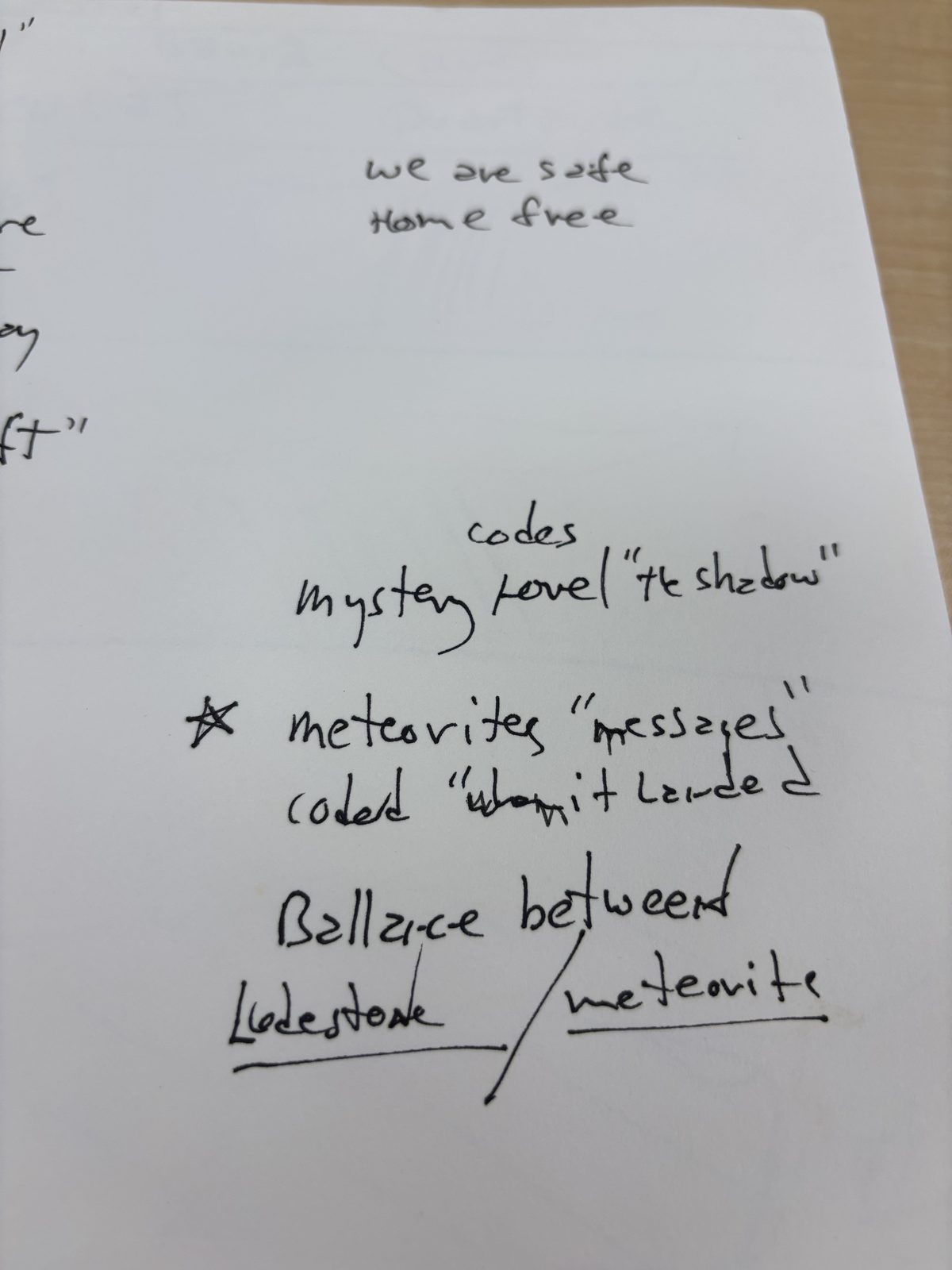
“Balance Between Lodestone / Meteorite”
IMG_1581
“Codes, mystery novel ‘the shadow,’ meteorites ‘messages’ coded ‘where it landed,’ Balance between lodestone / meteorite.”
11. Sculpture, Site Design & Broader Context
Concept sketches for the CIA courtyard installation, compass studies, and related contextual documents.
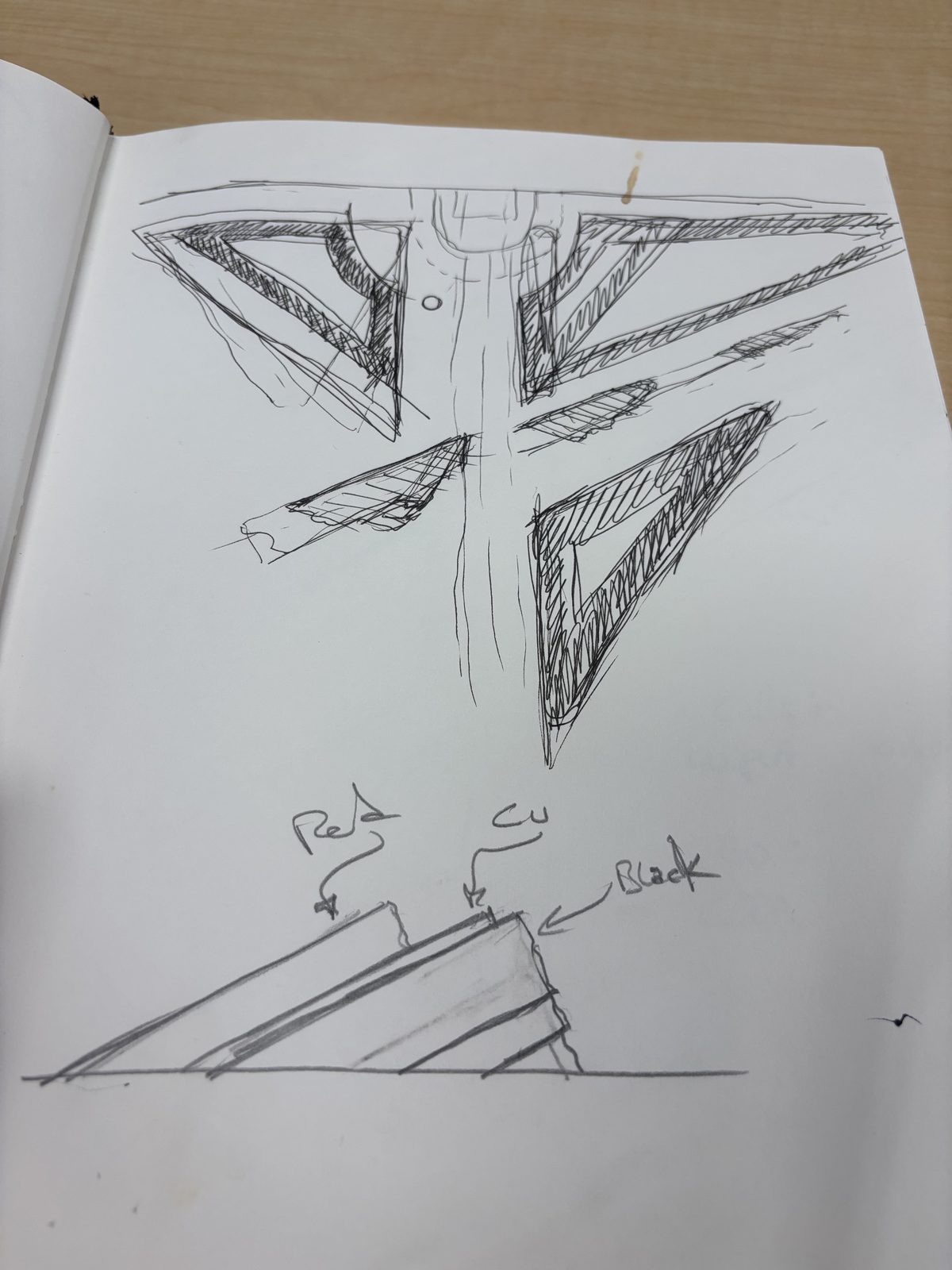
Morse Tables Concept Drawing
IMG_1587
Sanborn's original concept sketch for the CIA courtyard installation showing the distinctive V-shaped/triangular Morse code table elements. A material cross-section at the bottom labels the layers: “Red” (granite), “Cu” (copper), “Black” (stone). These color assignments appear deliberate and meaningful. They also map to navigation marker colors (red = port, green/copper patina = starboard), reinforcing the nautical symbolism found elsewhere in the archive (see IMG_1428, IMG_1614).
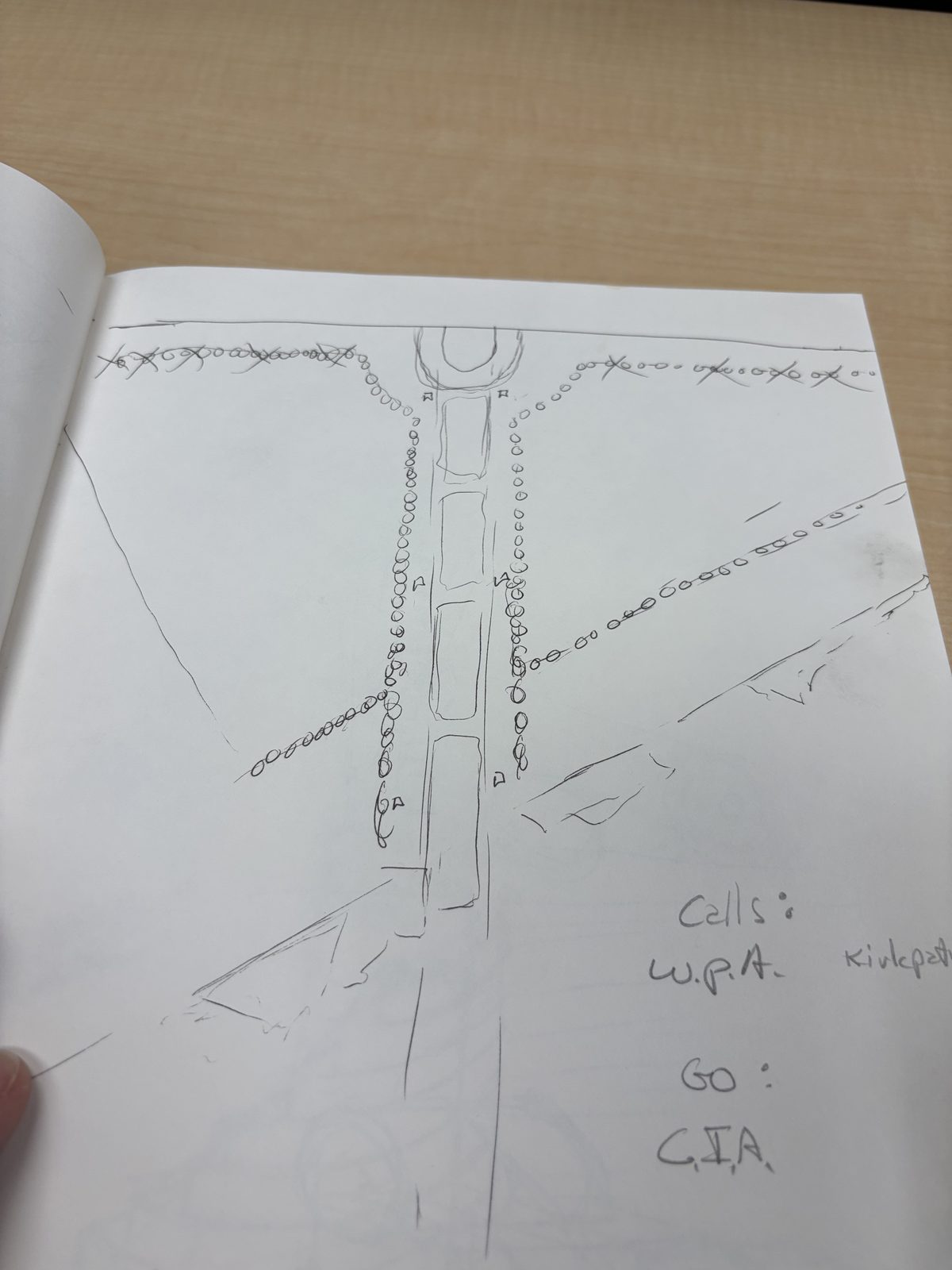
CIA Courtyard Site Plan
IMG_1591
Conceptual site plan for the Kryptos courtyard installation at CIA headquarters. The S-curve copper panel is visible in the center, surrounded by walkways and landscape elements (circles may indicate petrified wood or stone placement). Annotations read “Cells: W.P.A. Kirkpatrick” and “GO: C.I.A.” This sketch shows the spatial relationships between the installation components.
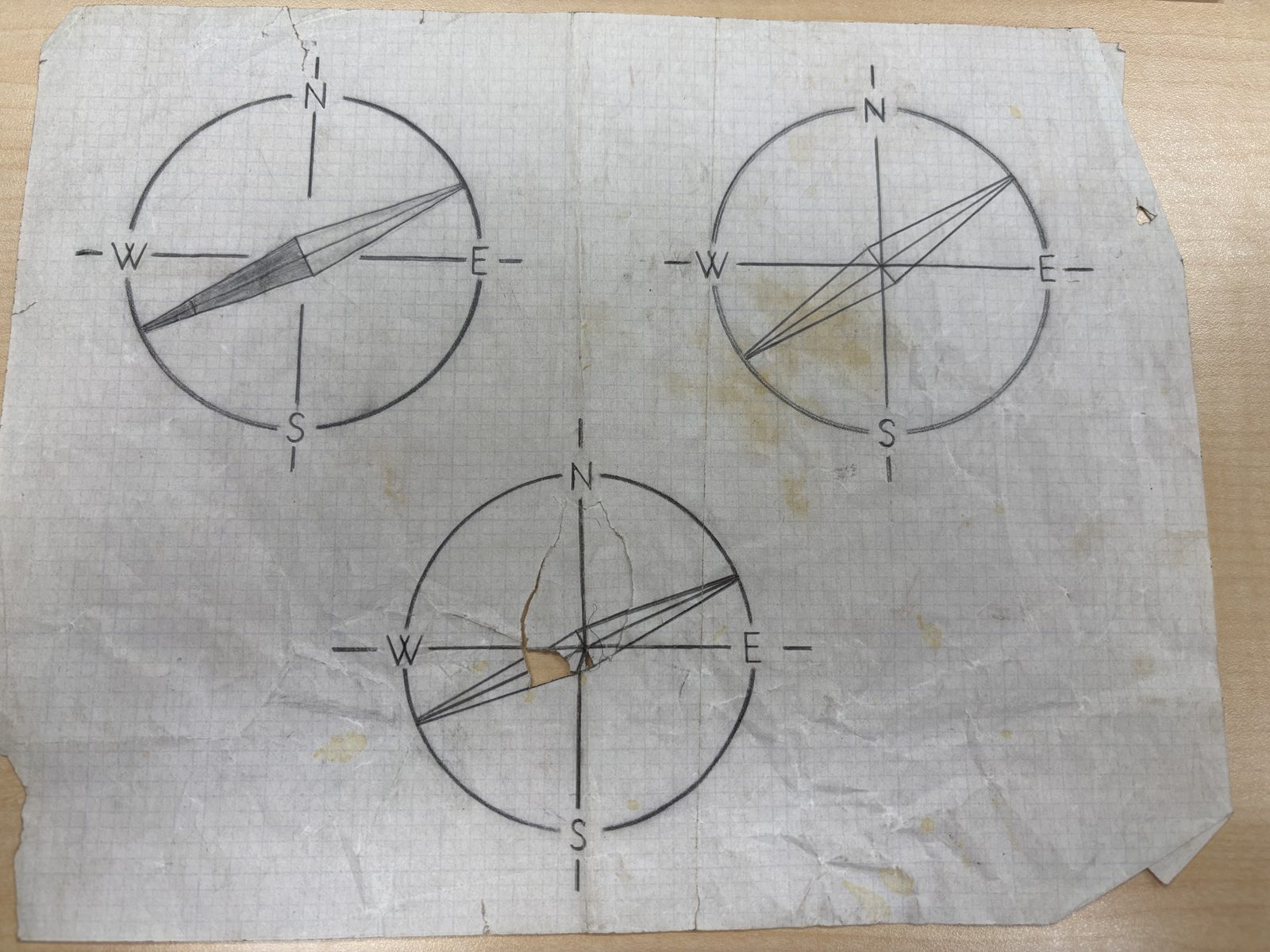
Compass Rose Studies
IMG_1518
Three hand-drawn compass roses on graph paper, each with N/S/E/W markers and directional lines radiating at specific angles. The lines suggest bearings or sight-lines rather than simple cardinal directions. The compass rose is a physical element of the Kryptos installation (surrounding the pool); these studies may reflect the design process for that element or encode directional information.
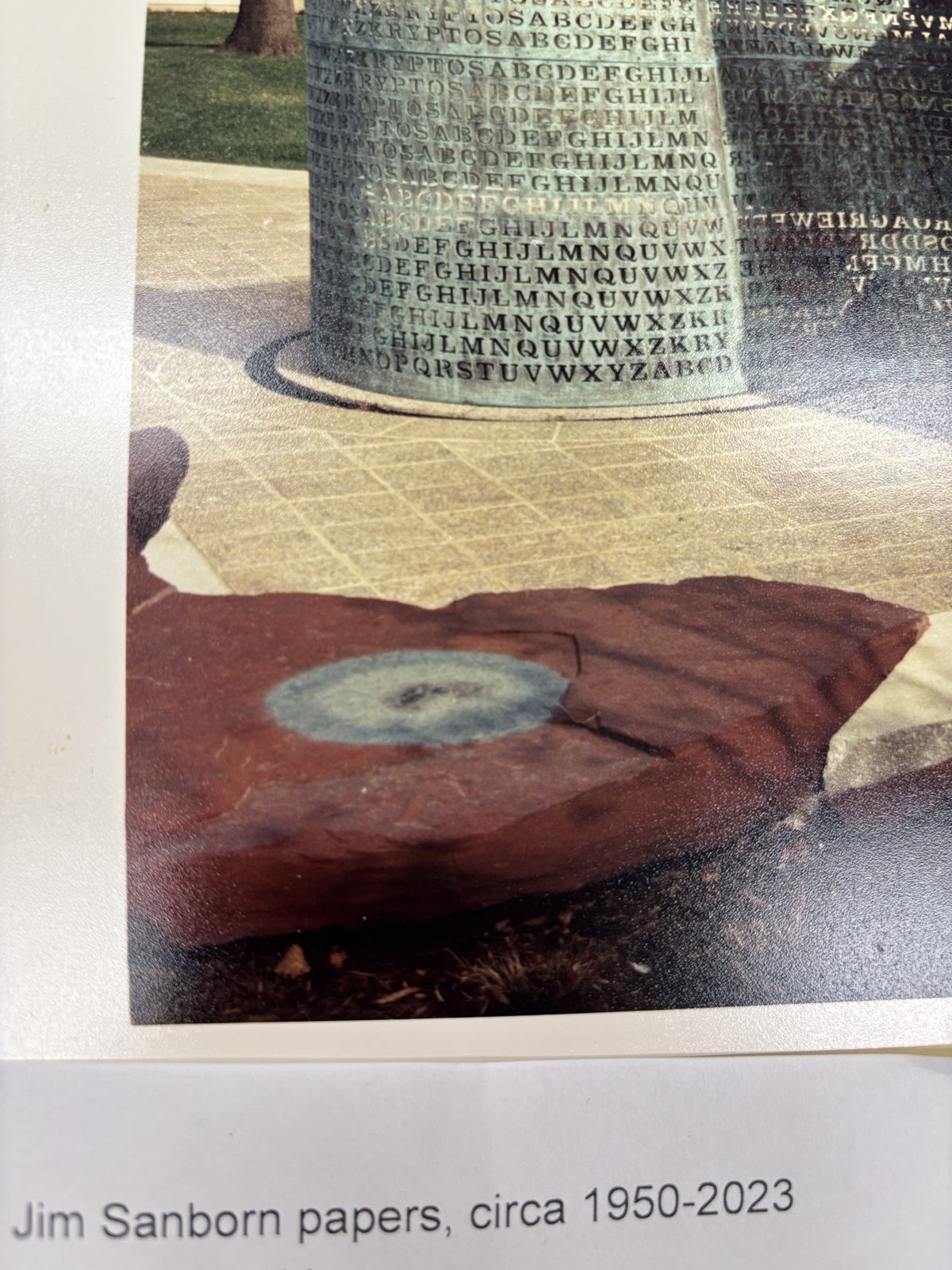
Red Granite Slab & Copper Patina Circle
IMG_1100
A piece of red granite at the Kryptos site with a prominent green-blue circular stain on its surface. The color and concentric ring pattern are consistent with copper patina (verdigris), the natural oxidation product of copper or bronze exposed to weather. The stain suggests a copper-bearing object sat on this stone for an extended period, with copper ions migrating outward through the granite's pore structure. The Kryptos sculpture itself is copper sheet, and the installation includes several metal elements. This is not a natural feature of the granite; it is a secondary surface deposit from an external copper source.
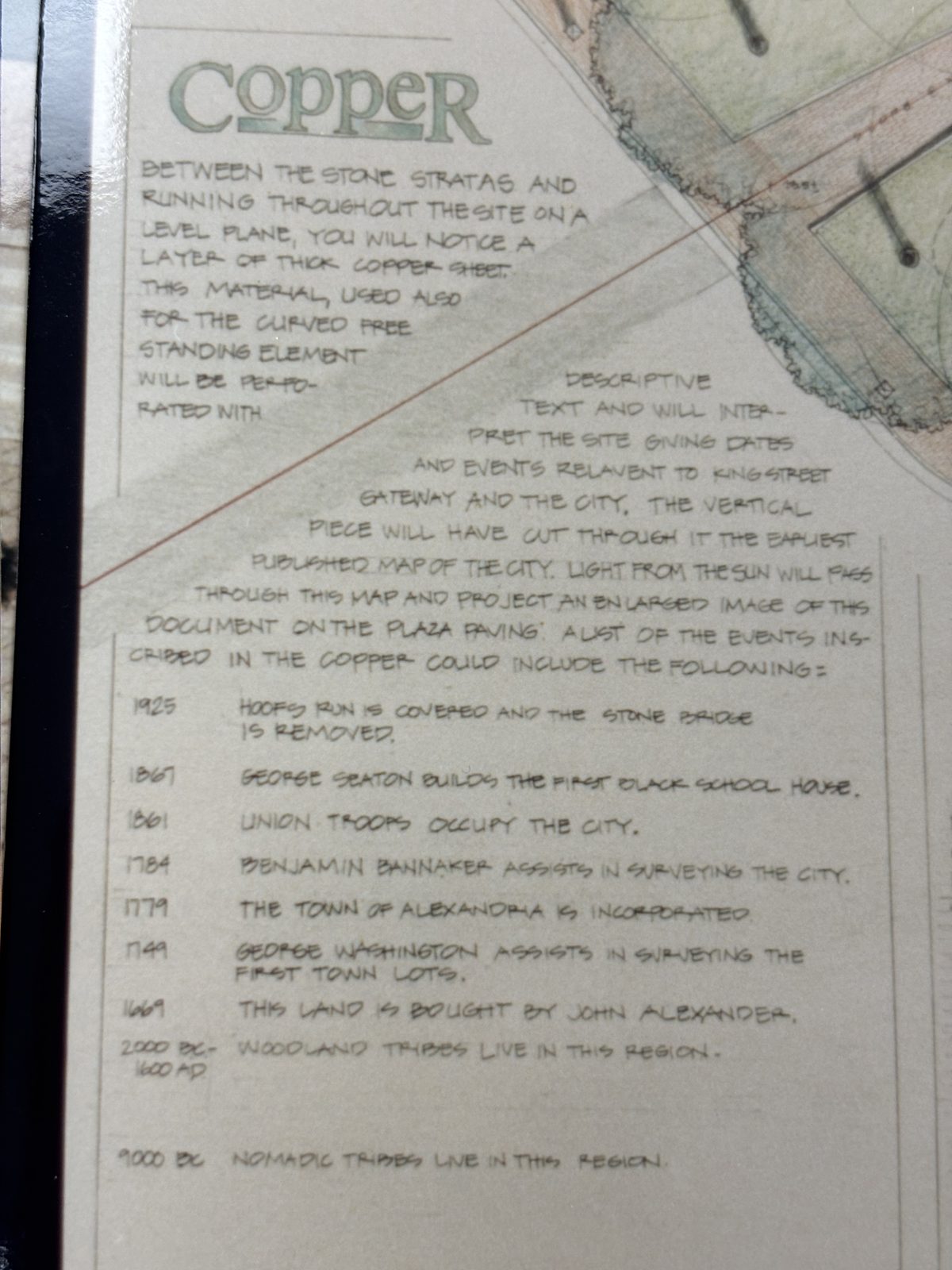
“Perforated with Descriptive Text”
IMG_1152
Description of another Sanborn installation using the same method as Kryptos: “perforated with descriptive text... Light from the sun will pass through this map and project an enlarged image.”
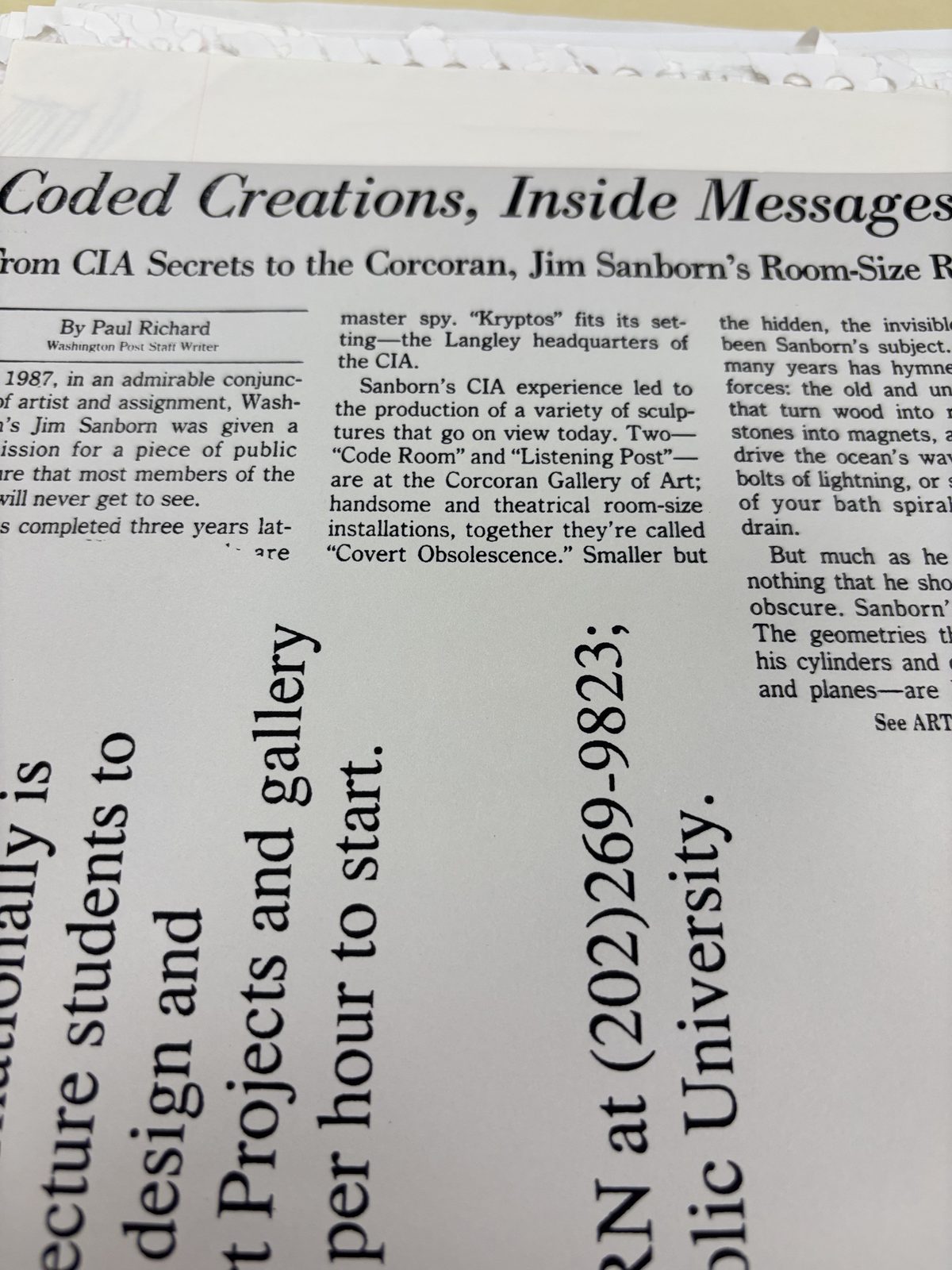
“Coded Creations, Inside Messages”
IMG_1492
Press article by Paul Richard: “From CIA Secrets to the Corcoran, Jim Sanborn's Room-Size [installations]...” Mentions “Code Room” and “Listening Post” installations, collectively called “Covert Obsolescence.”
12. Dan Brown & The Lost Symbol
After Dan Brown published The Lost Symbol (2009), Sanborn contacted his attorney over potential intellectual-property concerns. His lawyer’s memo (November 24, 2009) survives in the archive.
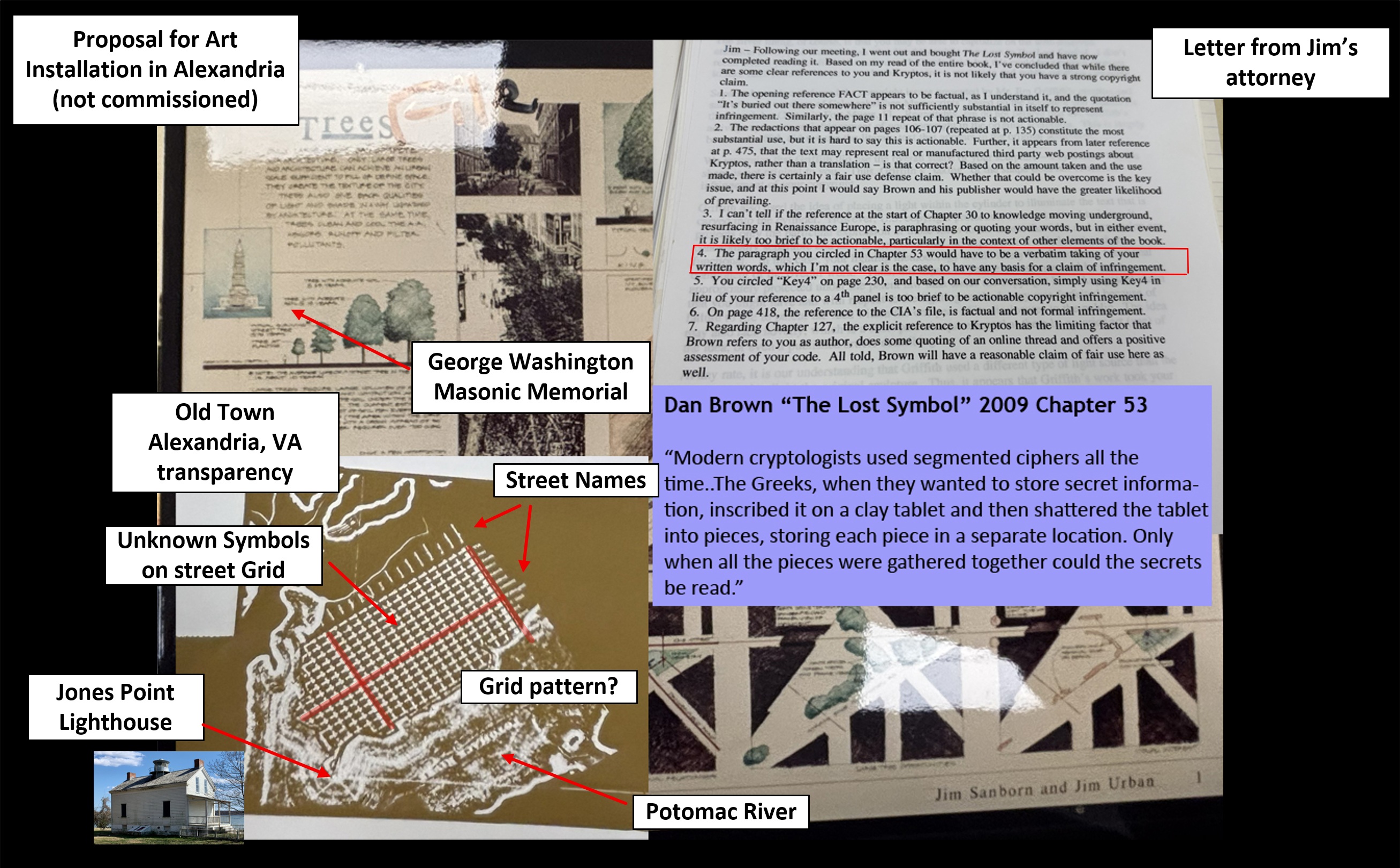
Chapter 53, Alexandria & the Masonic Connection
Composite (archival + reference)
Throughout The Lost Symbol, Brown refers to Kryptos by name and quotes it directly. Chapter 53, however, never mentions Kryptos, yet Sanborn circled it and flagged it for his lawyer. The chapter describes a 4×4 cipher square, “segmented ciphers” from ancient Greece, a “Masonic pyramid,” and the idea that a puzzle can only be solved by combining two separate elements. Sanborn grew up in the Alexandria–Arlington area. The Old Town Alexandria transparency in his Kryptos working papers (IMG_1221) points toward Jones Point, the original DC boundary marker, and the George Washington Masonic National Memorial. This composite collects the relevant archival and reference materials in one view.
About This Collection
The Jim Sanborn papers are held at the Archives of American Art, a bureau of the Smithsonian Institution. The selection presented here focuses on materials with direct or indirect relevance to Kryptos and its encryption. Many additional pages (business notes, unrelated installation documentation, and near-duplicate photos) were reviewed and excluded to maintain research density.
How to help: If you notice something in these images that we've missed, can provide a better transcription of any handwritten text, or can identify the source of any quoted material, please email contact@kryptosbot.com.